
Textile Fragment
Unknown Artist
probably 15th–16th century
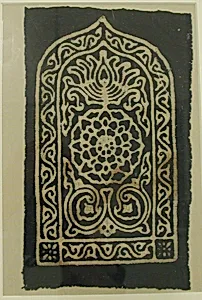
Medium
Cotton; plain weave, stamp resist dyed
Dimensions
Textile: H. 8 1/16 in. (20.5 cm) W. 5 1/16 in. (13.5 cm) Mount: H.11 1/8 in (28.3 cm) W. 14 1/4 in (36.2 cm)
Classification
Textiles-Painted and/or Printed
Department
Islamic Art
Museum
Metropolitan Museum of Art, New York, NY
Credit
Gift of Nelly, Violet and Elie Abemayor, in memory of Michel Abemayor, 1978
Accession Number
1978.546.51b
Rights
Public Domain
Art Historical Context
This delicate textile fragment, dating to the 15th–16th century, offers a glimpse into the sophisticated world of Islamic textile artistry. Crafted from cotton plain weave and adorned with stamp resist dyeing—a technique where motifs are stamped with a resist agent like wax or paste before immersion in dye—the small piece (just 8 by 5 inches) preserves vibrant patterns typical of the era. Housed in the Metropolitan Museum of Art's Department of Islamic Art, it the ingenuity of anonymous artisans who mastered colorfast designs resistant to fading. Stamp resist dyeing was a hallmark of Islamic textile production, likely originating from trade hubs in regions like India or the Middle East, where cotton flourished. This method allowed for intricate, repeating floral or geometric motifs that reflected Islamic aesthetic principles of harmony and repetition, often used in garments, turbans, or ceremonial hangings. Though a mere fragment, it speaks to the global exchange of techniques along Silk Road routes, blending utility with beauty. Gifted to the Met in 1978 in memory of Michel Abemayor, this artifact invites us to appreciate the enduring legacy of Islamic craftspeople, whose innovations influenced textiles far beyond their time.