
Textile Fragment
Unknown Artist
18th century
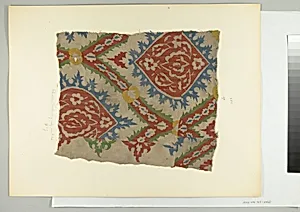
Medium
Silk, cotton; embroidered
Dimensions
H. 16 5/8 in. (42.2 cm) W. 14 3/8 in. (36.5 cm)
Classification
Textiles-Embroidered
Department
Islamic Art
Museum
Metropolitan Museum of Art, New York, NY
Credit
Gift of Nanette B. Kelekian, in honor of Olga Raggio, 2002
Accession Number
2002.494.707
Rights
Public Domain
Art Historical Context
This exquisite *Textile Fragment* from the 18th century offers a glimpse into the masterful embroidery traditions of Islamic art. Crafted from silk and cotton, it 16⅝ × 14⅜ inches (42.2 × 36.5 cm), showcasing the delicate interplay of luxurious fibers that were prized in the Islamic world for their sheen, durability, and symbolic richness. Silk, often imported along trade routes, evoked opulence and status, while cotton provided a versatile base for intricate needlework. In the 18th century, such embroidered textiles were integral to daily life and ceremony, adorning garments, furnishings, or ceremonial objects across regions like the Ottoman Empire, Persia, or Mughal India. The unknown artist's skill in embroidery—likely employing techniques like chain stitch or satin stitch—highlights the period's emphasis on geometric patterns, florals, and arabesques, which reflected Islamic principles of beauty, harmony, and infinity. These fragments survive as treasures, preserving cultural narratives through their fine craftsmanship. Now in the Metropolitan Museum of Art's Department of Islamic Art, this piece was a generous gift from Nanette B. Kelekian in honor of Olga Raggio in 2002. It invites visitors to appreciate the anonymous genius behind Islamic textile arts, where every thread tells a story of innovation and devotion.