
Textile Fragment
Unknown Artist
17th century
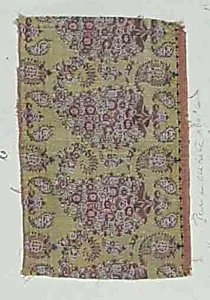
Medium
Silk, metal thread
Dimensions
H. 5 3/8 in. (13.7 cm) W. 8 1/4 in. (21 cm)
Classification
Textiles
Department
Islamic Art
Museum
Metropolitan Museum of Art, New York, NY
Credit
Gift of Nanette B. Kelekian, in honor of Olga Raggio, 2002
Accession Number
2002.494.724
Rights
Public Domain
Art Historical Context
This delicate textile fragment, dating to the 17th, hails from the Islamic world and showcases the era's masterful weaving traditions. Crafted from shimmering silk woven with luxurious metal threads—likely gold or silver— compact size (5 3/8 x 8 1/4 inches) suggests it once part of a larger garment, turban, or ceremonial hanging. Such fragments, preserved in museum collections like the Metropolitan Museum Art's Islamic Art department, offer a glimpse into the refined artistry of regions like the Ottoman Empire or Safavid Persia, where textiles were symbols of prestige and piety. The use of metal threads elevated these works to status symbols, reflecting advanced techniques such as supplementary weft weaving, which created intricate patterns and a tactile richness. In the 17th century, these opulent fabrics adorned elite wardrobes and mosque furnishings, blending functionality with spiritual motifs often inspired by nature or geometry. Donated in 2002 as a gift honoring curator Olga Raggio, this piece invites us to appreciate the anonymous weavers' skill, whose innovations influenced global trade in luxury goods.