
Textile Fragment
Unknown Artist
17th century
Medium
Silk, metal thread
Dimensions
H. 3 3/4 in. (9.5 cm) W. 4 3/8 in. (11.1 cm)
Classification
Textiles
Department
Islamic Art
Museum
Metropolitan Museum of Art, New York, NY
Credit
Gift of Nanette B. Kelekian, in honor of Olga Raggio, 2002
Accession Number
2002.494.732
Rights
Public Domain
Art Historical Context
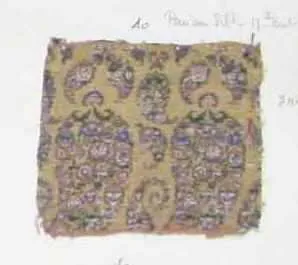
This delicate *Textile Fragment* from the th century offers a glimpse into the opulent world of Islamic art. Crafted from silk woven with shimmering metal threads—likely gold or silver—its modest dimensions (3 3/4 x 4 3/8 inches) suggest it is a surviving piece of a larger textile, possibly from a garment, curtain, or ceremonial object. Such fragments are treasures, preserving intricate patterns that once adorned elite households across the Islamic world, from the Ottoman Empire to Safavid Persia. In the 17th century, silk textiles enhanced with metal threads represented the pinnacle of technical virtuosity and luxury. Weavers employed complex techniques like lampas or brocading to integrate the metallic elements, creating a luminous effect that symbolized wealth and status. These fabrics were prized for export along trade routes, blending functionality with artistry and reflecting the era's cultural exchanges between Europe, Asia, and the Middle East. Today, this fragment graces the Metropolitan Museum of Art's Islamic Art Department, a gift from Nanette B. Kelekian in honor of Olga Raggio (2002). Though small, it whispers stories of forgotten splendor, inviting us to imagine the hands that wove it and the lives it enriched.