
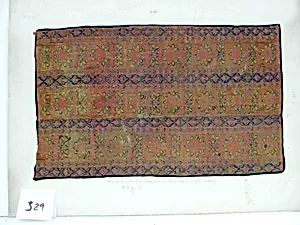
Textile Fragment
Unknown Artist
17th century
Medium
Silk
Dimensions
H. 21 3/4 in. (55.2 cm) W. 13 1/4 in. (33.7 cm)
Classification
Textiles
Department
Islamic Art
Museum
Metropolitan Museum of Art, New York, NY
Credit
Gift of Nanette B. Kelekian, in honor of Olga Raggio, 2002
Accession Number
2002.494.755
Rights
Public Domain
Art Historical Context
This exquisite silk textile fragment from the 17th century a glimpse into the opulent world of Islamic art. Housed in the Metropolitan Museum Art's Department of Islamic Art, it measures21 3/4 by 13 1/4 inches (55.2 by 33.7 cm) and was generously gifted by Nanette B. Kian in honor of Olgaaggio in 2002. As a surviving piece from a larger textile—likely a garment, curtain, or ceremonial hanging—it showcases the mastery of weaving techniques prevalent in the Islamic world during the height of empires like the Ottoman, Safavid, and Mughal. Silk, prized for its luster and durability, was a luxury medium symbolizing wealth and refinement. In the 17th century, Islamic artisans excelled in complex looms, producing fabrics with intricate patterns of florals, geometrics, and arabesques that reflected spiritual and natural motifs central to Islamic aesthetics. These textiles were not just functional but served as canvases for cultural storytelling, traded across Eurasia and influencing global design. Though the artist remains unknown, this fragment's preservation highlights the fragility and rarity of such works, inviting us to appreciate the anonymous genius behind Islamic textile traditions. A testament to enduring craftsmanship, it connects visitors to the vibrant trade routes and artistic innovation of the early modern Islamic world.