
Textile Fragments
Unknown Artist
5th–7th century
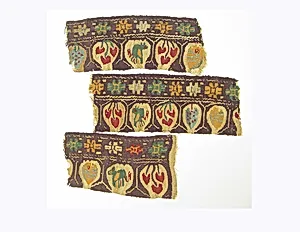
Medium
Wool, linen; tapestry weave
Dimensions
a: L. 7 1/2 in. (19.1 cm) W. 2 3/4 in. (7 cm) b: L. 6 5/8 in. (16.8 cm) W. 2 7/8 in. (7.3 cm)
Classification
Textiles
Department
Islamic Art
Museum
Metropolitan Museum of Art, New York, NY
Credit
Gift of David del Gaizo, 2008
Accession Number
2008.322.7a, b
Rights
Public Domain
Art Historical Context
These delicate textile fragments, dating to the 5th–7th century, offer a rare glimpse into the artistry of early Islamic or late antique weaving traditions. Crafted from wool and linen using the tapestry weave technique—a method where colored weft threads are woven discontinuously to create vibrant, pictorial designs without floating yarns—these small pieces (measuring about 7 inches long) likely originated from garments, furnishings, or ceremonial objects. Donated to the Metropolitan Museum of Art in 2008, they reside in the Islamic Art department, highlighting their connection to the burgeoning cultural world of the Near East and Egypt during this transformative era. The 5th–7th centuries marked a pivotal transition from Byzantine, Sasanian, and pre-Islamic societies to the early Islamic caliphates, a time when textiles served as symbols of status, trade, and piety. Tapestry weave, known for its durability and ability to depict intricate motifs like animals, geometrics, or floral patterns (though specifics here are fragmentary), was a sophisticated craft requiring skilled labor, often produced in urban workshops or monasteries. Preserved fragments like these are invaluable, as organic materials rarely survive antiquity. They reveal the technical prowess and aesthetic sensibilities that influenced later Islamic textile traditions, from Abbasid silks to Ottoman carpets, underscoring textiles' role in daily life, commerce along the Silk Roads, and cultural exchange. A quiet testament to forgotten hands, they invite us to imagine the colors and stories woven into the fabric of history.