
Sleeve Fragment with Floral Motives
Unknown Artist
6th–9th century
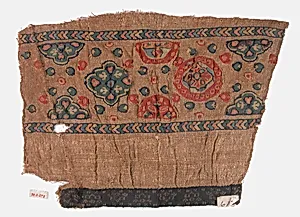
Medium
Wool, linen; plain weave, tapestry weave
Dimensions
H. 8 1/4 in. (21 cm) W. 10 13/16 in. (27.5 cm)
Classification
Textiles
Department
Islamic Art
Museum
Metropolitan Museum of Art, New York, NY
Credit
Gift of George F. Baker, 1890
Accession Number
90.5.273
Rights
Public Domain
Art Historical Context
This delicate sleeve fragment, adorned with intricate floral motifs, hails from the 6th–9th century and exemplifies early Islamic textile artistry. Measuring just 8¼ by 10⅞ inches, it once formed part of a garment, offering a tantalizing glimpse into the daily elegance of wearers in the Islamic world during a formative era bridging late antiquity and the Abbasid Caliphate. Floral patterns like these were not merely decorative; they symbolized paradise gardens in Islamic culture, evoking abundance and spiritual beauty. Crafted from wool and linen using plain weave for the ground and tapestry weave for the motifs, the piece showcases sophisticated techniques that allowed artisans to create vibrant, durable designs. Tapestry weave, where colored weft threads are woven to form patterns without floats, produced a smooth, reversible surface ideal for clothing. These methods highlight the technical prowess of early Islamic weavers, who blended local traditions with emerging cultural motifs. Preserved as a gift from George F. Baker in 1890, this fragment now resides in the Metropolitan Museum of Art's Islamic Art Department. It reminds us how textiles were vital canvases for artistic expression in pre-modern societies, surviving centuries to connect us with forgotten hands.