
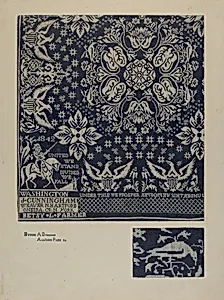
Textile of George Washington
1935/1942
Medium
watercolor, graphite, and pen and ink on paper
Dimensions
overall: 61.8 x 47 cm (24 5/16 x 18 1/2 in.) Original IAD Object: 78" wide; 94" long
Classification
Index of American Design
Department
CG-W
Museum
National Gallery of Art, Washington, D.C.
Credit
Index of American Design
Accession Number
1943.8.2643
Rights
Public Domain
Art Historical Context
Behold the *Textile of George Washington a meticulous 1935/1942 rendering by artist Byron Dingman, capturing the intricate details of an early American fabric design. Created using watercolor, graphite, and pen and ink on paper (61.8 x 47 cm), this work documents a grand original textile measuring 78 inches wide by94 inches long. Dingman's skilled hand brings to life the patriotic motif of George Washington, likely woven or printed in vibrant patterns that evoke the nation's founding spirit. This artwork is a gem from the Index of American Design (IAD), a landmark WPA Federal Art Project from the 1930s and early 1940s. During the Great Depression, artists like Dingman produced over 15,000 precise watercolor studies of everyday American objects—from quilts to furniture—to celebrate and preserve the country's folk art heritage. Housed in the National Gallery of Art's CG-W department, it highlights how decorative textiles embodied cultural pride and craftsmanship. The piece's cultural importance lies in its dual role: as both an artistic record and a tribute to American identity. Washington's image on such textiles was common in the 19th century, symbolizing heroism amid historical challenges. Dingman's technique—layering ink for outlines, graphite for shading, and watercolor for rich hues—ensures the design's textures and colors endure, inviting visitors to appreciate our shared design legacy.
About the Artist
Byron Dingman · 1886–1951
Byron Dingman (1886–1951) was an American artist whose career, though sparsely documented in personal terms, gained significance through his contributions to the Index of American Design, a New Deal-era Federal Art Project under the Works Progress Administration (WPA). Active primarily in the late 1930s and early 1940s, Dingman produced meticulous renderings of everyday American folk art objects, ...