
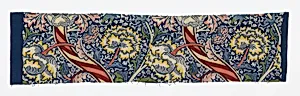
Textile
late 19th century
Classification
printed, dyed & painted textiles
Department
Smithsonian Collection
Museum
Smithsonian American Art Museum
Credit
Gift of Robert W. Friedel
Accession Number
1951-103-24
Rights
Public Domain
About this artwork
Research in Progress
Art Historical Context
This exquisite textile from Morris & Co., a pioneering London firm founded by William Morris in 1861, exemplifies the late 19th-century Arts and Crafts movement. Active during the height of the Industrial Revolution, Morris & Co. championed handcrafted designs that revived medieval techniques and celebrated nature's beauty, countering mass-produced goods with intricate, nature-inspired patterns—often floral motifs like acanthus leaves or pomegranate fruits. Classified as a printed, dyed, and painted textile, this piece highlights the company's innovative methods: woodblock printing for precise motifs, vegetable dyes for rich, fade-resistant colors, and hand-painting for personalized details. These labor-intensive processes underscored Morris's philosophy that everyday objects should inspire joy and quality, influencing modern design from Liberty prints to contemporary interiors. Now part of the Smithsonian American Art Museum's collection through the gift of Robert W. Friedel, this textile invites us to appreciate the tactile artistry of a bygone era. Research continues to uncover its precise patterns and provenance, but its presence evokes the enduring appeal of Morris's vision: beauty accessible to all. (198 words)
About the Artist
Morris & Co., (London, England) ( ) · 1770 –1815
active ca. 1770–1815