
Textile
1780–1810
Medium
printed, dyed & painted textiles
Classification
printed, dyed & painted textiles
Department
Smithsonian Collection
Museum
Smithsonian American Art Museum
Credit
Bequest of Elinor Merrell
Accession Number
1995-50-30
Rights
Public Domain
About this artwork
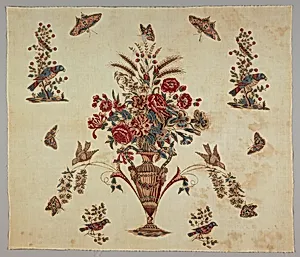
Natural-colored square printed with a central urn of flowers and wheat stalks surrounded by isolated motifs of butterflies, and birds in trees and on sprigs. Printed in black, blue, tan, yellow, and two shades of red.
Art Historical Context
This vibrant textile by John Hewson, an English-born printer active in America from the 1770s, exemplifies the artistry of early American calico production during the late 18 to early 19th century. Dated between 1780 and 1810, the natural-colored square features a central neoclassical urn overflowing with flowers and wheat stalks—symbols of abundance and prosperity—framed by delicate motifs of butterflies, birds perched in trees, and sprigs. Hewson's masterful use of black, blue, tan,, and two shades of creates a lively, balanced composition that would have adorned clothing, curtains, or bedcovers in fashionable households. Hewson pioneered multi-color block printing in Philadelphia, importing techniques from England while adapting to American tastes amid post-Revolutionary growth in domestic manufacturing. His textiles, often dyed and hand-painted for depth, bridged British traditions with emerging Federal-era aesthetics, favoring pastoral and natural themes reflective of Enlightenment ideals of harmony with nature. Now in the Smithsonian American Art Museum through the bequest of Elinor Merrell, this piece highlights Hewson's legacy as a founder of U.S. textile innovation, offering a tangible glimpse into everyday luxury and the era's blend of utility and ornament.