
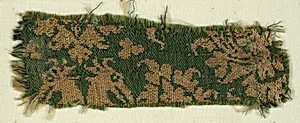
Textile with Figures
Unknown Artist
14th century
Medium
Silk
Dimensions
Overall: 1 1/4 × 3 3/4 in. (3.2 × 9.5 cm) Storage (Mat with 09.50.985-.987): 8 1/2 × 13 in. (21.6 × 33 cm)
Classification
Textiles-Woven
Culture
Italian
Department
Medieval Art
Museum
Metropolitan Museum of Art, New York, NY
Credit
Rogers Fund, 1909
Accession Number
09.50.985
Rights
Public Domain
Art Historical Context
This delicate silk textile fragment, woven in 14th-century Italy, offers a glimpse into the opulent world of medieval luxury goods. Measuring just 1¼ × 3¾ inches, it features woven figures that exemplify the intricate pictorial weaving techniques of the era. Produced during Italy's late Gothic period, when cities like Lucca and Venice emerged as silk production powerhouses, such textiles were prized for their fine luster and vibrant dyes, often imported from the East and adapted into local designs. Silk weaving required masterful skill on drawlooms, allowing weavers to create detailed human figures integrated into patterns—likely for ecclesiastical vestments, noble garments, or decorative hangings. As a status symbol, these fabrics bridged Byzantine influences with emerging Italian Renaissance sensibilities, showcasing cultural exchange along trade routes. Acquired through the Rogers Fund in 1909, this piece highlights the Metropolitan Museum of Art's commitment to preserving fragile medieval artifacts. Though small, its survival speaks to the enduring artistry of anonymous craftsmen, inviting us to imagine it adorning a grand altar or royal chamber centuries ago. A testament to Italy's textile heritage, it underscores how everyday materials became canvases for storytelling in the Middle Ages.