
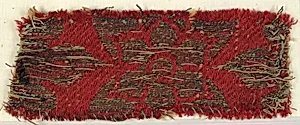
Textile with Flower Motive
Unknown Artist
14th century
Medium
Silk, linen, gold thread
Dimensions
Overall: 1 9/16 × 3 7/8 in. (4 × 9.8 cm) Storage (Mat): 5 1/2 × 8 1/4 in. (14 × 21 cm)
Classification
Textiles-Woven-Brocade
Culture
Italo-Arabic
Department
Medieval Art
Museum
Metropolitan Museum of Art, New York, NY
Credit
Rogers Fund, 1909
Accession Number
09.50.991
Rights
Public Domain
Tags
Art Historical Context
This exquisite 14th-century *Textile with Flower Motive* is small fragment of woven brocade, measuring just 1 9/16 × 3 7/8 inches, from luxurious silk, linen, and gold thread. Housed in the Metropolitan Museum Art's Medieval Art departmentacquired through the Rogers Fund in 9), it exemplifies theulent textiles produced during a vibrant era of cultural exchange. The delicate floral patterns, a hallmark tag of the piece, evoke the lush gardens of medieval imagination, rendered with intricate precision. Its Italo-Arabic classification highlights the fusion of Italian and Islamic artistic traditions, likely originating from Sicily or southern Italy under Norman-Arab rule. In this multicultural hub, Arab weaving techniques met European tastes, producing brocades prized for ecclesiastical vestments, noble garments, and furnishings. The use of gold thread—woven as supplementary wefts—created a raised, metallic sheen that caught the light, symbolizing wealth and divine splendor. As a survivor of centuries, this tiny textile offers a window into medieval luxury crafts. Brocade's complex loom process required skilled artisans, making such pieces rare treasures that bridged East and West, influencing Renaissance textiles to come. Visitors, imagine it adorning a bishop's cope or a palace hanging—timeless beauty in thread.