
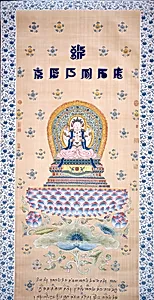
Thanka (Religious Picture)
Qing dynasty (1644–1911), 1743/44
Medium
Silk, slit tapestry weave with interlaced outlining wefts; painted details in colors, black, and with gold leaf; outer scroll top: silk, warp-float faced 5:1 satin weave with supplementary patterning wefts and self-patterned by ground weft floats; scroll wrapper: silk, warp-float faced 5:1 satin weave with 1:2 'S' twill interlacings of secondary binding warps and supplementary patterning wefts and self-patterned by main warp and ground weft floats; rayon and cotton ties; scroll wrapper lined with silk, warp-float faced 2:1 'S' twill weave self-patterned by areas of plain weave
Dimensions
371.1 × 126.2 cm (146 × 49 3/4 in.) Wrapper: 128.4 × 42.1 cm (50 1/2 × 16 1/2 in.) Cover repeat: 56.4 × 12 cm (22 1/4 × 4 3/4 in.) Lining repeat (width): 16.5 cm (6 1/2 in.)
Classification
textile
Department
Textiles
Museum
Art Institute of Chicago
Accession Number
12346
Rights
Public Domain
About the Artist
Manchu
"Manchu" is a cultural and ethnic designation used in museum collection records to identify objects, textiles, costumes, and decorative arts associated with the Manchu people, a Tungusic group originating from the regions northeast of the Great Wall of China. The Manchus rose to political dominance in 1644 when they conquered the declining Ming dynasty and established the Qing dynasty, which ruled...