
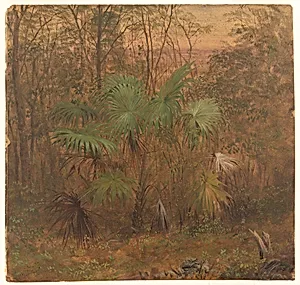
Thatch Palm, Jamaica
Classification
nature studies
Department
Smithsonian Collection
Museum
Smithsonian American Art Museum
Credit
Gift of Louis P. Church
Accession Number
1917-4-672-a
Rights
Public Domain
About this artwork
Research in Progress
Art Historical Context
Frederic Edwin Church, leading figure of the Hudson River School, captured the exotic beauty of the Caribbean in *Thatch Palm, Jamaica* during a trip in May 1865. Amid the turmoil of the post-Civil War United States, Church sought respite from his debilitating rheumatoid arthritis by traveling to Jamaica, where he sketched the island's lush flora. This nature study reflects his meticulous observation of the natural world, a hallmark of his precise, almost scientific approach to landscape art that celebrated America's wilderness and beyond. As part of the Smithsonian American Art Museum's collection—gifted by Church's son, Louis P. Church—this work exemplifies the artist's fascination with tropical environments, honed from earlier expeditions to South America. Though the medium remains unidentified amid ongoing research, its classification as a nature study highlights Church's preparatory sketches, which often informed his grand oil paintings like *Heart of the Andes*. These intimate studies reveal the intimate details of a thatch palm's textured fronds, evoking the sublime power of nature that defined Romanticism in 19th-century American art. Visitors to the virtual galleries can appreciate how *Thatch Palm, Jamaica* bridges Church's personal healing journey with his enduring legacy, inviting us to marvel at the quiet drama of a single tree in a distant paradise.