
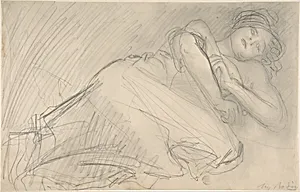
The Abandoned
ca. 1902
Medium
Graphite with stumping
Dimensions
7 9/16 x 11 7/8 in. (19.4 x 30.4 cm)
Classification
Drawings
Department
Drawings and Prints
Museum
Metropolitan Museum of Art, New York, NY
Credit
Rogers Fund, 1910
Accession Number
10.45.20
Rights
Public Domain
Tags
Art Historical Context
Auguste Rodin, celebrated primarily as a sculptor of the human form, reveals his sensitive draftsmanship in *The Abandoned* (ca. 1902). Executed in graphite with stumping—a technique that softens and blends lines to create atmospheric depth—this modest sheet captures the quiet vulnerability of a female figure. The medium allows Rodin to explore subtle gradations of light and shadow, conveying emotional resonance without the weight of bronze or marble. Created at the turn of the twentieth century, when Rodin was at the height of international fame, the drawing reflects his lifelong fascination with the expressive potential of body. Though best known for monumental public sculptures, Rodin treated works on paper as independent explorations of movement, gesture, and inner states. The title and the solitary woman suggest themes of loss and isolation that recur throughout his oeuvre, inviting viewers to sense narrative tension in a single, economical pose. Acquired by the Metropolitan Museum in 1910, *The Abandoned* offers an intimate glimpse into the artist’s process. It demonstrates how Rodin’s drawings, like his sculptures, prioritize feeling and form over finish, bridging nineteenth-century realism with emerging modernist concerns.
About the Artist
Auguste Rodin · 1840–1917
François Auguste René Rodin (1840-1917) stands as the founder of modern sculpture, transforming the art form from academic tradition into expressive modernism. Born into a working-class Parisian family, Rodin faced early rejection, failing three times to gain admission to the prestigious École des Beaux-Arts. This setback forced him to work as a craftsman for nearly two decades, though his 1875 tr...