
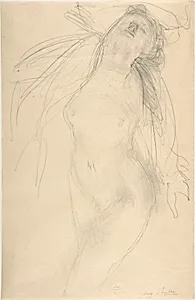
Female nude reclining
1909–1910
Medium
Graphite with stumping
Dimensions
14 3/16 in. x 9 1/4 (36.1 x 23.5 cm)
Classification
Drawings
Department
Drawings and Prints
Museum
Metropolitan Museum of Art, New York, NY
Credit
Gift of Thomas F. Ryan, 1913
Accession Number
13.164.4
Rights
Public Domain
Tags
Art Historical Context
In the twilight of his illustrious career, Auguste Rodin created *Female Nude Reclining* around 1909–1910, a delicate graphite drawing that captures the sculptor's enduring fascination with the human form Best known for monumental bronzes like *The Thinker* and *The Kiss*, Rodin was equally masterful as a draughtsman, producing of studies that explored anatomy, movement, and emotion. This intimate work, measuring 14 3/16 × 9 1/4 inches, exemplifies his late style: fluid lines and subtle modeling that evoke the sensuous curves of the reclining figure, a motif rooted in classical antiquity yet infused with modern vitality. Rodin's use of graphite with stumping—a technique blending the medium with a soft stump for velvety tones—brings the nude's skin to luminous life, blurring edges to suggest warmth and depth. Housed in the Metropolitan Museum of Art's Drawings and Prints department since a 1913 gift from Thomas F. Ryan, this piece highlights the nude's timeless role in Western art, from Renaissance masters to Impressionist explorations of light and flesh. It invites viewers to appreciate Rodin's genius in translating three-dimensional sculpture into two-dimensional poetry, celebrating the body's natural grace.
About the Artist
Auguste Rodin · 1840–1917
François Auguste René Rodin (1840-1917) stands as the founder of modern sculpture, transforming the art form from academic tradition into expressive modernism. Born into a working-class Parisian family, Rodin faced early rejection, failing three times to gain admission to the prestigious École des Beaux-Arts. This setback forced him to work as a craftsman for nearly two decades, though his 1875 tr...