
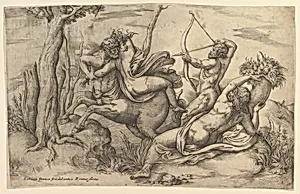
The Abduction of Dejanira
16th century
Medium
Etching and engraving, state ii
Dimensions
sheet: 9 5/8 x 15 1/4 in. (24.5 x 38.7 cm) trimmed to platemark
Classification
Prints
Department
Drawings and Prints
Museum
Metropolitan Museum of Art, New York, NY
Credit
Harris Brisbane Dick Fund, 1926
Accession Number
26.70.3(228)
Rights
Public Domain
Tags
Art Historical Context
In the dynamic etching and engraving *The Abduction of Deira*, created by Venetian artist Battista Franco in the 16 century, we witness a dramatic moment from Greek mythology. centaur Nessus seizes the beautiful Dejanira, wife of Hercules, in a scene pulsing with tension—evident from the tags highlighting male and female nudes, centurs, bows and arrows, and lush trees. Franco, a key figure in the Venetian Renaissance with Mannerist leanings, drew inspiration from masters like Michelangelo, infusing the composition with muscular forms and expressive energy that capture the myth's raw passion and peril. This state II impression, measuring 9 5/8 x 15 1/4 inches, showcases Franco's mastery of mixed printmaking techniques: etching for fluid, spontaneous lines evoking movement, and engraving for sharp, intricate details in figures and foliage. Prints like this were revolutionary in the 1500s, democratizing access to grand artistic narratives beyond paintings, allowing collectors across Europe to own replicas of mythological epics. Acquired through the Harris Brisbane Dick Fund in 1926 and housed in the Metropolitan Museum of Art's Drawings and Prints department, this work highlights the Renaissance fascination with classical antiquity and the nude body as a vehicle for heroic drama. Visitors, imagine Hercules' arrow poised in the distance— a timeless tale of love, jealousy, and tragedy etched for eternity.
About the Artist
Battista Franco · 1510–1561
Battista Franco, known as il Semolei, was born in Venice around 1510, though his career unfolded largely in Rome and at the courts of central and northern Italy. He came to Rome in his twenties and immediately fell under two powerful spells: the inexhaustible riches of classical antiquity and the overwhelming presence of Michelangelo. Franco spent years making drawings after ancient sculptures and...