
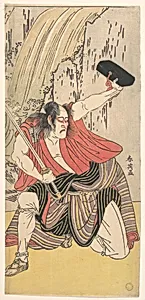
The Actor Ichikawa Komazo II as a Man Armed with a Sword
Medium
Woodblock print; ink and color on paper
Dimensions
H. 12 1/4 in. (31.1 cm); W. 5 11/16 in. (14.4 cm)
Classification
Prints
Culture & Period
Japan · Edo period (1615–1868)
Department
Asian Art
Museum
Metropolitan Museum of Art, New York, NY
Credit
Rogers Fund, 1922
Accession Number
JP1350
Rights
Public Domain
Tags
Art Historical Context
Created by Katsukawa Shun'ei in 1789, this woodblock print captures the celebrated kabuki actor Ichikawa Komazo II in a dramatic role, sword in hand. As a member of the influential Katsukawa school, Shun'ei specialized in actor portraits that conveyed both likeness and the intensity of performance. The vertical format, known as hosoban, was popular for such single-figure compositions, allowing the artist to emphasize the actor’s expressive pose and costume details through bold lines and subtle color washes. During Japan’s Edo period, ukiyo-e prints like this one brought the excitement of the kabuki stage to a wide audience. Actors were cultural celebrities, and prints served as both souvenirs and affordable art. Shun’ei’s work reflects the lively theater culture of late-eighteenth-century Edo (modern Tokyo), where dramatic sword fights and heroic roles thrilled spectators. Printed with ink and color on paper, the piece exemplifies the technical refinement of Japanese woodblock printing, which combined skilled carving and registration to produce vibrant, reproducible images. Today it offers viewers a vivid glimpse into the intersection of performance, fashion, and popular art in pre-modern Japan.
About the Artist
Katsukawa Shun'ei 勝川春英 (Japanese) · 1762 –1819
Japanese, 1762–1819