
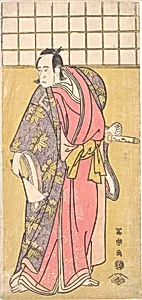
The Actor Ichikawa Yaozō III
ca. 1794
Medium
Woodblock print; ink and color on paper (hoso-e, Yellow ground)
Dimensions
12 31/32 x 6 11/32 in. (33 x 16.1 cm)
Classification
Prints
Culture & Period
Japan · Edo period (1615–1868)
Department
Asian Art
Museum
Metropolitan Museum of Art, New York, NY
Credit
The Howard Mansfield Collection, Purchase, Rogers Fund, 1936
Accession Number
JP2647
Rights
Public Domain
Tags
Art Historical Context
In the vibrant world of Edo-period Japan (1615–1868), Tōshūsai Sharaku captured the dramatic essence of kabuki theater with his striking woodblock print *The Actor Ichikawa Yaoō III* (ca. 1794). This hoso-e, or narrow-format print on yellow-ground paper, measures just 33 x 16.1 cm, making it ideal for mounting on fans—a popular accessory for theatergoers. Sharaku, a mysterious artist active for only about a year, revolutionized ukiyo-e ("pictures of the floating world") by portraying actors not as idealized beauties, but as intensely expressive individuals mid-performance. The print showcases Ichikawa Yaozō III, a celebrated kabuki performer, in a dynamic pose that highlights his emotional depth and theatrical prowess. Sharaku's bold use of ink and color on paper, achieved through meticulous woodblock carving, creates sharp contours, vivid hues, and a psychological intensity rare in contemporary portraits. The yellow ground adds a luminous warmth, evoking the glow of stage lanterns. Housed in the Metropolitan Museum of Art's Asian Art collection (The Howard Mansfield Collection, Purchase, Rogers Fund, 1936), this work exemplifies how ukiyo-e democratized art, bringing kabuki stardom into everyday life. Visitors today can appreciate its cultural snapshot of 18th-century Japan's entertainment scene, where actors were larger-than-life celebrities.
About the Artist
Tōshūsai Sharaku · 1794–1795
Tōshūsai Sharaku stands as one of the most enigmatic figures in Japanese art history, a ukiyo-e printmaker whose brilliant career blazed for just ten months from the summer of 1794 to early spring 1795. Active exclusively in Edo (modern Tokyo), he produced approximately 150 woodblock prints and sketches, primarily yakusha-e—intimate portraits of kabuki actors captured mid-performance. Published by...