
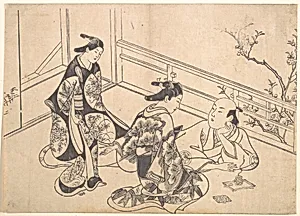
The Actor Ichimura Takenojo Reclining on a Balcony
ca. 1715
Medium
Monochrome woodblock print (sumie); ink on paper
Dimensions
10 x 14 in. (25.4 x 35.6 cm)
Classification
Prints
Culture & Period
Japan · Edo period (1615–1868)
Department
Asian Art
Museum
Metropolitan Museum of Art, New York, NY
Credit
The Howard Mansfield Collection, Purchase, Rogers Fund, 1936
Accession Number
JP2639
Rights
Public Domain
Tags
Art Historical Context
In the vibrant world of Edo-period Japan (1615–1868), Okumura Masanobu's *The Actor Ichimura Takenojoclining on a Bal* (ca. 1715) captures the allure of kabuki theater. This monochrome woodblock (sumie) portrays the famed actor Ichimura Takenojō in a relaxed pose on a balcony, evoking fleeting pleasures of the "floating world" (ukiyo-e). Masanobu, a pioneering printmaker active in early 18th-century Edo (modern Tokyo), helped popularize affordable, single-sheet prints that brought theater stars to everyday audiences. Rendered in delicate ink washes on paper (10 x 14 in.), the sumie technique emphasizes subtle gradations of tone and bold outlines, mimicking traditional ink painting while showcasing woodblock precision. This early format predates the multicolored ukiyo-e prints of later masters like Hiroshige, highlighting Masanobu's innovative use of chiaroscuro for depth and drama—rare in prints of the time. Culturally, such yakusha-e (actor prints) idolized kabuki performers, blending artistry with celebrity culture. Housed in the Metropolitan Museum of Art's Asian Art collection (The Howard Mansfield Collection, 1936), it offers a window into Japan's theatrical golden age, where men like Takenojō often played female roles, blurring gender lines on stage and page. A charming snapshot of 18th-century entertainment!
About the Artist
Okumura Masanobu · 1686–1764
Japanese, 1686–1764