
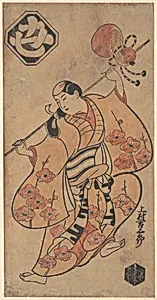
The Actor Kakimura Kichisaburo as a Dancing Girl
ca. 1705
Medium
Woodblock print; ink and color on paper
Dimensions
11 3/5 x 5 31/32 in. (29.5 x 15.2 cm)
Classification
Prints
Culture & Period
Japan · Edo period (1615–1868)
Department
Asian Art
Museum
Metropolitan Museum of Art, New York, NY
Credit
The Francis Lathrop Collection, Purchase, Frederick C. Hewitt Fund, 1911
Accession Number
JP681
Rights
Public Domain
Tags
Art Historical Context
Step into the vibrant world of Edo-period Japan *The Actor Kakimura Kichaburo as a Dancing*, a captivating woodblock print by Torii Kiyonobu I, created around 1705. This intimate hosoban-format print (11 3/5 x 5 31/32 in.) showcases the kabuki actor in a graceful female role, frozen mid-dance with flowing robes and expressive poise. Kiyonobu, a founder of the Torii school, specialized in yakusha-e—dynamic portraits of theater stars that brought the stage to the streets. During Japan's Edo period (1615–1868), kabuki theater exploded in popularity, blending drama, music, and dance. Male actors like Kakimura Kichisaburo excelled as onnagata, masterfully embodying women in roles such as dancing girls, challenging gender norms while dazzling audiences. These prints, inked and hand-colored on paper, served as affordable souvenirs and advertisements, democratizing access to high culture. Kiyonobu's bold lines and vivid colors highlight the print's artistic innovation, marking an early pinnacle of ukiyo-e's "floating world" aesthetic—celebrating fleeting pleasures like theater. Housed in the Metropolitan Museum of Art's Asian Art Department, this piece from The Francis Lathrop Collection invites you to appreciate how woodblock mastery captured the rhythm of performance and the allure of transformation.
About the Artist
Torii Kiyonobu I · 1664–1729
Torii Kiyonobu I (1664–1729), born Shōbei in Osaka, was the second son of Torii Kiyomoto, a prominent kabuki actor specializing in onnagata roles and a painter of theater signboards. He studied painting under his father as well as Yoshida Hanbei and Hishikawa Moronobu, the pioneering ukiyo-e master whose figure styles profoundly shaped his early work. In 1687, at age twenty-four, Kiyonobu accompan...