
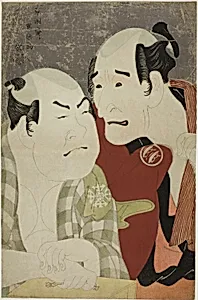
The actors Nakajima Wadaemon (R) as Bodara Chozaemon and Nakamura Konozo (L) as Gon of the boat-keeper Kanagawaya
1794
Medium
Color woodblock print; oban
Dimensions
38.1 × 24.8 cm (15 × 9 13/16 in.)
Classification
woodblock print
Department
Arts of Asia
Museum
Art Institute of Chicago
Accession Number
18891
Rights
Public Domain
Art Historical Context
Step into the vibrant world of 18th-century Japanese kabuki theater with Tōshūsai Sharaku's *The actors Nakajima Wada (R) as Bodara Chozaemon and Nakamuraonozo (L) as Gon of the boat- Kanagawaya* (1794). This striking color woodblock print in the oban format—measuring 38.1 × 24.8 cm—captures two performers in dynamic poses, showcasing their dramatic roles from a popular play. Produced during the Edo period, it belongs to the ukiyo-e tradition, or "pictures of the floating world," which celebrated everyday pleasures like theater. Sharaku, a enigmatic artist active for just ten months in 1794, revolutionized yakusha-e (actor prints) with his bold, psychological portraits. Unlike the idealized depictions common in ukiyo-e, his works feature intense expressions, exaggerated features, and meticulous lines that reveal the actors' raw emotion and individuality. Printed on a large oban sheet using intricate woodblock techniques—where carved blocks were inked and layered for vivid colors—this piece highlights the technical mastery of Japanese printmaking. Housed in the Art Institute of Chicago's Arts of Asia department, this print offers a window into kabuki's cultural fervor, where star actors were celebrities akin to modern idols. Sharaku's brief output of around 150 designs left an indelible mark, influencing later artists and underscoring theater's role in Edo society's escapism.
About the Artist
Tōshūsai Sharaku · 1794–1795
Tōshūsai Sharaku stands as one of the most enigmatic figures in Japanese art history, a ukiyo-e printmaker whose brilliant career blazed for just ten months from the summer of 1794 to early spring 1795. Active exclusively in Edo (modern Tokyo), he produced approximately 150 woodblock prints and sketches, primarily yakusha-e—intimate portraits of kabuki actors captured mid-performance. Published by...