
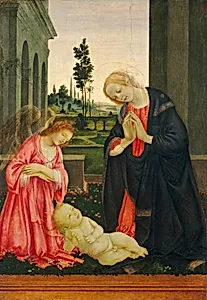
The Adoration of the Child
c. 1475/1480
Medium
oil on poplar panel
Dimensions
painted surface: 81.5 x 56.3 cm (32 1/16 x 22 3/16 in.) support: 82.5 x 57.3 cm (32 1/2 x 22 9/16 in.) framed: 117.2 x 91.1 x 8.3 cm (46 1/8 x 35 7/8 x 3 1/4 in.)
Classification
Painting
Department
CIS-R
Museum
National Gallery of Art, Washington, D.C.
Credit
Andrew W. Mellon Collection
Accession Number
1937.1.18
Rights
Public Domain
Art Historical Context
Filippino Lippi's *The Adoration of the* (c. 147/1480), an oil painting on poplar panel, a tender moment of divine intimacy. Measuring about 81.5 x 56.3 cm, this intimate devotional work depicts the Virgin Mary gazing lovingly at the infant Christ, a quintessential Renaissance theme maternal devotion and the humanity of the sacred. Housed in the National Gallery of Art as part of the Andrew W Mellon Collection, it invites viewers into the quiet reverence of early Christian iconography. Lippi, a prominent Florentine painter (1457–1504) and son of Fra Filippo Lippi, trained under Sandro Botticelli, blending his mentor's graceful linearity with a distinctive narrative charm. Active during the late quattrocento, he contributed to Florence's vibrant artistic scene, including frescoes in the Brancacci and Strozzi Chapels. Oil on poplar panel—a lightweight, locally sourced medium—allowed Lippi to achieve luminous glazes and fine details, hallmarks of the emerging oil technique that would revolutionize Northern and Italian art. This painting reflects the Renaissance shift toward emotional realism and humanism in religious art, making the holy accessible for private contemplation. Its survival from Lippi's early career underscores his rising mastery, offering museum visitors a window into 15th-century Florence's spiritual and artistic fervor.
About the Artist
Filippino Lippi · 1457–1504
Filippino Lippi was born around 1457 in Prato, the illegitimate son of the celebrated Florentine painter Fra Filippo Lippi and the nun Lucrezia Buti, who later received a papal dispensation to marry. The family moved to Spoleto, where young Filippino assisted in his father's workshop on the fresco cycle *Life of the Virgin* in the cathedral. Following Fra Filippo's death in 1469, when Filippino wa...