
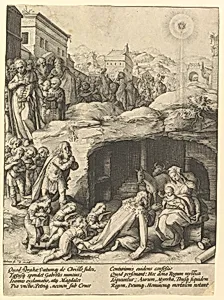
The Adoration of the Magi
Medium
Engraving; second state of three
Dimensions
sheet: 7 13/16 x 5 3/4 in. (19.9 x 14.6 cm)
Classification
Prints
Department
Drawings and Prints
Museum
Metropolitan Museum of Art, New York, NY
Credit
The Elisha Whittelsey Collection, The Elisha Whittelsey Fund, 1951
Accession Number
51.501.4433
Rights
Public Domain
Tags
Art Historical Context
This engraving, *The Adoration of the Magi*, captures the biblical moment when the three wise men present gifts to the infant Jesus, a theme long celebrated in Christian art for its message of reverence and divine revelation. Created around 1585 by Dutch printmaker Hendrick Goltzius in collaboration with Italian artist Bernardino Passeri, the work reflects the vibrant exchange of ideas between Northern Europe and Italy during the late Renaissance. As an engraving—the second state of three—it demonstrates the meticulous technique of incising designs into metal plates, allowing for fine detail and the production of multiple impressions that could reach audiences far beyond a single painting. Goltzius, a leading figure in Northern Mannerism, brought his characteristic energy and precision to the medium, transforming Passeri’s design into a dynamic composition rich with expressive figures and intricate textures. Engravings like this played a vital cultural role in the sixteenth century, serving as affordable, portable works that spread religious imagery and artistic innovation across Europe. Measuring just under eight by six inches, this intimate print from the Metropolitan Museum’s collection invites close viewing, revealing the skill and care that made such works treasured objects for both devotion and study.
About the Artist
Hendrick Goltzius|Bernardino Passeri · 1558–1617
Hendrick Goltzius (1558–1617) was the most celebrated engraver of the Northern Renaissance and a pivotal figure in Dutch Mannerism. Born near the German-Dutch border, Goltzius transformed printmaking into a virtuoso art form through his revolutionary 'swelling line' technique, where the burin was manipulated to create lines of varying thickness that produced unprecedented tonal effects and three-d...