
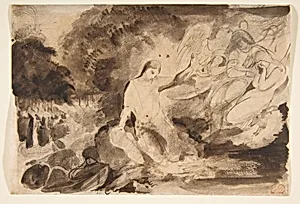
The Agony in the Garden
1823–24
Medium
Brush and brown wash over graphite
Dimensions
Overall: 5 1/4 x 7 5/8 in. (13.4 x 19.4 cm)
Classification
Drawings
Department
Drawings and Prints
Museum
Metropolitan Museum of Art, New York, NY
Credit
Gift from the Karen B. Cohen Collection of Eugène Delacroix, in memory of Jacob Bean, 2013
Accession Number
2013.1135.4
Rights
Public Domain
Tags
Art Historical Context
In the dim solitude of the Garden of Gethsemane, Eugène Delacroix captures a pivotal moment from the Passion of Christ in *The Agony in the* (1823–24). This intimate drawing depicts Jesus in prayer, overwhelmed by anguish before his betrayal and arrest, a scene rich with emotional intensity that aligns perfectly with the Romantic movement's emphasis on human suffering, spirituality, and the sublime forces of nature. Created early in Delacroix's career, just before his breakthrough *Dante and Virgil in Hell* (1822) brought him fame, it reflects his fascination with dramatic biblical narratives and his debt to Baroque masters like Rubens. Executed in brush and brown wash over graphite on a modest scale (5¼ × 7⅝ inches), the work showcases Delacroix's masterful use of wash technique—a fluid application of diluted ink—to evoke shadowy depths and luminous highlights. The brown tones build a moody atmosphere, with graphite underdrawing providing precise contours for Christ's expressive pose amid garden foliage. As a preparatory study, it reveals the artist's iterative process, blending line and tone in a way that foreshadowed his later oil paintings' vibrant color and movement. Housed in the Metropolitan Museum of Art's Drawings and Prints department, this gem from the Karen B. Cohen Collection of Eugène Delacroix highlights the French master's genius in monochrome. For visitors, it offers a window into Romanticism's heart: raw emotion rendered with technical brilliance.
About the Artist
Eugène Delacroix · 1798–1863
Eugène Delacroix (1798–1863) stands as the defining figure of French Romanticism and a pivotal bridge to modernism. Born in Charenton-Saint-Maurice near Paris, he came from distinguished lineage—his mother descended from the prestigious Oeben-Riesener furniture dynasty, while persistent speculation suggested the statesman Talleyrand may have been his biological father, a theory supported by physic...