
Study of a Pyramid
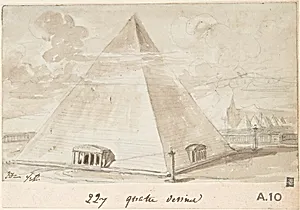
Medium
Brush and brown wash over graphite
Dimensions
3 5/8 x 6 1/16 in. (9.2 x 15.4 cm)
Classification
Drawings
Department
Drawings and Prints
Museum
Metropolitan Museum of Art, New York, NY
Credit
Edward Pearce Casey Fund, 1979
Accession Number
1979.617
Rights
Public Domain
Tags
Art Historical Context
Jacques-Louis David, the preeminent French Neoclassical painter of the late 18th and early 19th centuries, created this intimate *Study of a Pyramid* graphite underdrawing enhanced by brush and brown wash. At just 3 5/8 x 6 1/16 inches, this undated sheet exemplifies the artist's meticulous preparatory technique, where loose graphite lines capture the pyramid's monumental form, and translucent brown wash adds depth and shadow, evoking the ancient structure's solidity and mystery. David's Neoclassicism drew heavily from Greco-Roman antiquity, but this drawing reflects the era's growing fascination with Egypt, fueled by Napoleon's 1798 expedition and the subsequent "Egyptomania" that swept Europe. Though not a finished composition, the study reveals David's analytical eye for proportion and form—hallmarks of his revolutionary history paintings like *The Oath of the Horatii*. Such sketches offered artists a way to distill grand architectural motifs into portable studies, bridging classical ideals with exotic allure. Housed in the Metropolitan Museum of Art's Drawings and Prints department, this work invites us to glimpse David's creative process, reminding visitors of how even towering pyramids could inspire the precision of a master's hand.
About the Artist
Jacques Louis David · 1748–1825
Jacques-Louis David (1748–1825), born in Paris on August 30 to a prosperous family, faced early tragedy when his father was killed in a duel around age nine. Raised by his mother's two architect uncles after his mother departed, David overcame family resistance to architecture and a facial tumor that hindered his speech and studies at the Collège des Quatre-Nations. He began training under the Roc...