
The agony in the garden
c. 1652
Medium
etching
Dimensions
83; 111
Rights
Public Domain
About this artwork
signature and date: ‘Rembrandt f 165-’
Art Historical Context
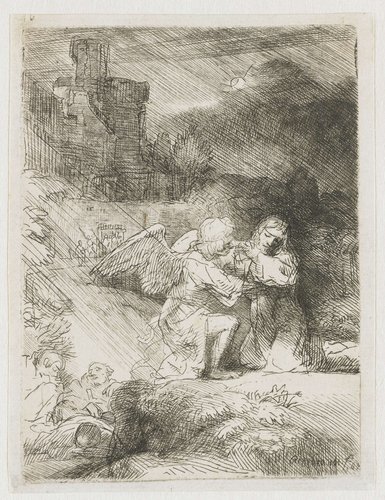
### The Agony in the Garden Rembrandt van Rijn's *The Agony in the*, created around 1652, captures a pivotal biblical moment from the New Testament: Jesus praying in anguish in the Garden of Gethsem just before his betrayal and arrest. Signed and dated ‘Rembrandt f 165-’, this intimate etching measures a modest 111mm high by 83mm wide, inviting close contemplation. As a cornerstone of the Dutch Golden Age, Rembrandt (1606–1669) was a master of Baroque drama, blending profound emotion with technical brilliance in his religious works. Etching allowed Rembrandt to achieve unprecedented depth and texture on a small scale, using a needle to incise lines into a copper plate coated in acid-resistant ground. His innovative use of drypoint and burr—rough, velvety lines—creates dramatic chiaroscuro effects, with light piercing the shadowy garden to spotlight Christ's solitude and the sleeping apostles. This technique not only heightens the spiritual tension but also showcases Rembrandt's printmaking genius, making his etchings highly sought after even in his lifetime. Produced during Rembrandt's mature period amid personal and financial struggles, this work reflects the era's deep Protestant engagement with scripture. Its cultural resonance endures, exemplifying how a tiny print can evoke universal themes of suffering and redemption, drawing visitors into the master's empathetic gaze on humanity.
About the Artist
Rembrandt van Rijn · 1606–1669
Rembrandt Harmenszoon van Rijn (1606–1669) stands as one of the greatest visual artists in the history of Western art and the most important Dutch painter of the 17th century. Born in Leiden to a prosperous miller's family, Rembrandt transformed painting through his revolutionary use of light and shadow, his psychological depth in portraiture, and his elevation of etching to a fine art. His approx...