
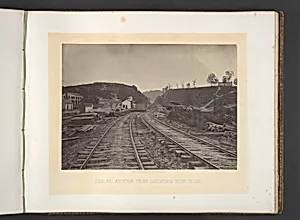
The Allatoona Pass Looking North, Georgia
1860s
Medium
Albumen silver print from glass negative
Classification
Photographs
Department
Photographs
Museum
Metropolitan Museum of Art, New York, NY
Credit
Pfeiffer and Rogers Funds, 1970
Accession Number
1970.525 (29)
Rights
Public Domain
Tags
Art Historical Context
George N. Barnard's *The Allatoona Pass North, Georgia* captures pivotal landscape from the American Civil War era likely during Union General William T. Sherman's 1864 Atlanta Campaign. Allatoona Pass, a mountain gap along the Western & Atlantic Railroad, was a strategic chokepoint for Confederate supply lines. Barnard's photograph, taken in the 1860s, documents the rugged terrain vital railway infrastructure that both armies fought to control, offering visitors a stark glimpse into the war's impact on Georgia's countryside. As an albumen silver print from a glass negative, this work exemplifies mid-19th-century photographic innovation. The albumen process, using egg whites to bind light-sensitive silver salts, produced rich tonal gradations and fine details, making it ideal for large-scale documentary prints. Barnard, a pioneering Civil War photographer, hauled heavy equipment to remote sites, creating enduring records of destruction and endurance amid Sherman's March to the Sea. Today, housed in The Metropolitan Museum of Art's Photographs Department, this image underscores photography's role in shaping historical memory. It invites reflection on how railways symbolized industrial might and wartime vulnerability, blending artistry with raw historical testimony.
About the Artist
George N. Barnard · 1819–present
George N. Barnard (1819–1902) was a pioneering American photographer whose six-decade career spanned the dawn of the medium, from daguerreotypes to Civil War documentation. Born into a farming family in Coventry, Connecticut, on December 23, 1819, he lost his father at age seven and apprenticed in family businesses before marrying in 1843 and relocating to Oswego, New York. There, he launched one ...