
The Angel at the Tomb of Christ
ca. 1812
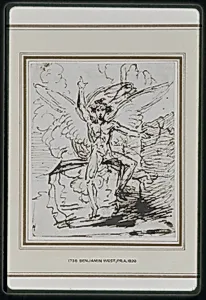
Medium
Pen and iron-gall ink on white laid paper
Dimensions
4 1/2 x 3 3/4 in. (11.4 x 9.5 cm)
Classification
Drawing
Culture
American
Department
The American Wing
Museum
Metropolitan Museum of Art, New York, NY
Credit
Gift of Leo Steinberg, 1992
Accession Number
1992.185
Rights
Public Domain
Tags
About this artwork
Benjamin West's "The Angel at the Tomb of Christ" (circa 1812) represents the American-born artist's mature neoclassical style applied to biblical narrative. This small drawing (4 1/2 x 3 3/4 inches) in pen and iron-gall ink depicts the resurrection account from Matthew 28:1-10, when women visiting Christ's sepulchre encountered an angel who announced the resurrection. West created multiple versions of this subject, including a large 1805 oil (Brooklyn Museum) and an 1801 lithograph (Cleveland M...
Art Historical Context
Benjamin West's *The Angel at the Tomb Christ* (ca. 1812) captures a pivotal moment from the Gospel of Matthew (28:1-10), where women at Christ's empty sepulchre encounter a radiant angel proclaiming the resurrection. This intimate drawing, just 4½ x 3¾ inches, executed in pen and iron-gall on laid paper, showcases the American-born artist's (1738–1820) mastery during his mature neoclassical phase. West, who rose from Pennsylvania roots to become history painter to King George III president of London's Royal Academy, drew inspiration from Roman neoclassicists like Anton Rafael Mengs, blending theological depth with archaeological precision. West's neoclassical style shines in the drawing's confident linear draftsmanship, where balanced compositions, expressive gestures, and detailed costumes evoke grand monumentality within a compact format. He pioneered vivid, historically informed depictions of biblical narratives, influencing Romantic artists like his student John Singleton Copley. This work joins West's series on the subject, including a large 1805 oil at the Brooklyn Museum and an 1801 lithograph in Cleveland, highlighting his lifelong fascination with resurrection themes. A gift to the Metropolitan Museum of Art from scholar Leo Steinberg in 1992, this gem from The American Wing underscores West's enduring bridge between colonial America and European art traditions, inviting visitors to ponder faith's dramatic power through exquisite simplicity.
About the Artist
Benjamin West · 1738–1820
Benjamin West, born on October 10, 1738, in Springfield, Pennsylvania, emerged as one of the most influential painters of his era despite being entirely self-taught. Growing up in a Quaker family in colonial America, West displayed prodigious talent from childhood, creating portraits and religious scenes with materials gifted by local patrons. By his late teens, he had garnered enough support to t...