
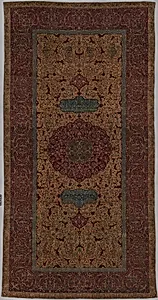
The Anhalt Medallion Carpet
Unknown Artist
probably first half 16th century
Medium
Cotton (warp), silk (weft), wool (pile); asymmetrically knotted pile
Dimensions
Rug: H. 312 in. (792.5 cm) W. 165 in. (419.1 cm) Wt. on 8" tube - 184 lbs. (83.5 kg)
Classification
Textiles-Rugs
Department
Islamic Art
Museum
Metropolitan Museum of Art, New York, NY
Credit
Gift of Samuel H. Kress Foundation, 1946
Accession Number
46.128
Rights
Public Domain
Tags
Art Historical Context
The Anhalt Medallion Carpet, dating to the first half of the sixteenth century, stands as a remarkable example of early modern Islamic textile art. Created with a cotton warp, silk weft, and wool pile using the asymmetrically knotted technique, this expansive rug measures over twenty-six feet in length. Its impressive scale and intricate construction reflect the high level of skill and resources devoted to carpet weaving during this period, when such works served both practical and decorative purposes in elite settings. The carpet’s design features prominent medallions surrounded by delicate peacocks, flowering vines, and scrolling foliage. These motifs evoke themes of paradise gardens and natural abundance frequently celebrated in Islamic art. The use of silk in the weft adds a subtle sheen and durability, while the wool pile provides the rich texture and depth that have allowed the piece to endure for centuries. Housed in the Metropolitan Museum of Art’s Islamic Art department, this work highlights the cultural exchange and artistic sophistication of its era. Gifted by the Samuel H. Kress Foundation in 1946, it offers visitors a window into the luxurious textile traditions that once adorned palaces and important residences across the Islamic world.