
The Animal Lover (Der Tierfreund)
1918
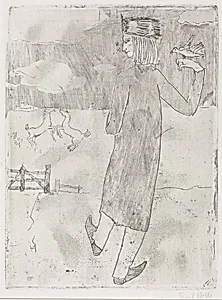
Medium
etching and aquatint
Classification
Department
CG-W
Museum
National Gallery of Art, Washington, D.C.
Credit
Rosenwald Collection
Accession Number
1950.17.340
Rights
Public Domain
Art Historical Context
Emil Nolde’s 1918 print *The Animal Lover (Der Tierfreund)* captures the German Expressionist’s fascination with raw emotion and the natural world during a turbulent era. Created at the close of World War I, the work reflects the broader Expressionist impulse to reject academic tradition in favor of direct, personal feeling. Nol, associated with the influential group Die Brücke, often explored themes of human-animal connection as a means of expressing primal vitality and spiritual intensity. Executed in etching and aquatint, the print demonstrates the artist’s mastery of intaglio techniques. These mediums allowed him to achieve rich tonal contrasts and velvety textures that heighten the emotional charge of the image. Printmaking was especially significant for Expressionists like Nolde, offering an accessible way to circulate their bold visions beyond elite galleries. The title suggests a tender, almost reverent portrayal of companionship between humans and animals, a motif that resonated in the post-war period when many sought solace in simpler, more authentic relationships. Part of the Rosenwald Collection at the National Gallery of Art, this work exemplifies Nolde’s ability to infuse even modest formats with profound psychological depth.
About the Artist
Emil Nolde · 1867–1956
Emil Nolde, born Hans Emil Hansen on August 7, 1867, near the village of Nolde in what was then Prussian Schleswig (now Denmark), grew up on a farm amid devout Protestant Danish and Frisian peasant parents. The youngest of four brothers, he apprenticed as a woodcarver and illustrator in Flensburg from 1884 to 1891, working in furniture factories before studying at the School of Applied Arts in Kar...