
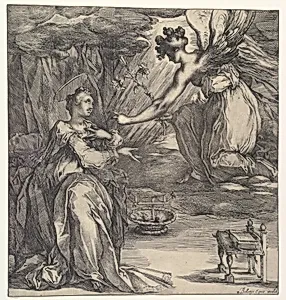
The Annunciation
Medium
etching and engraving; second state of three
Dimensions
image: 13 3/16 x 12 9/16 in. (33.5 x 31.9 cm), trimmed to image
Classification
Prints
Department
Drawings and Prints
Museum
Metropolitan Museum of Art, New York, NY
Credit
The Elisha Whittelsey Collection, The Elisha Whittelsey Fund, 1948
Accession Number
48.13.3
Rights
Public Domain
Tags
Art Historical Context
Jacques Bellange’s *The Annunciation* captures the pivotal biblical moment when the Archangel Gabriel appears to the Virgin Mary to announce her role in the Incarnation. Rendered in etching and engraving, the print conveys the scene with delicate linework and subtle tonal gradations, allowing fine details such as the folds of drapery and floral motifs to emerge clearly. The presence of flowers alongside the two figures underscores traditional symbols of purity and divine favor associated with this sacred encounter. As a print existing in multiple states, this work highlights the technical refinement possible in early modern printmaking. The second state reveals Bellange’s careful adjustments to composition and texture, demonstrating how artists used etching and engraving to achieve both expressive freedom and precise control. Measuring just over thirteen inches square, the intimate scale invites close viewing, rewarding the observer with the intricate interplay of line and form. Housed in the Metropolitan Museum of Art’s Department of Drawings and Prints, this impression entered the collection in 1948 through the Elisha Whittelsey Fund. It offers visitors a window into the devotional imagery that circulated widely through prints, extending the reach of religious narratives beyond the walls of churches and palaces.
About the Artist
Jacques Bellange · 1570–1616
Jacques Bellange (c. 1575–1616) was a French artist and printmaker active in the independent Duchy of Lorraine, now part of France. Believed to have been born in the Bassigny region south of Nancy, his early life and training remain sparsely documented, with no records of specific teachers or mentors. He first appears in historical records in 1595 at La Mothe, where he took on an apprentice, sugge...