
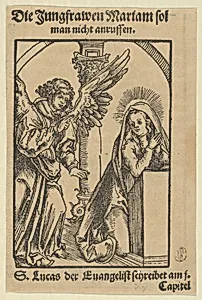
The Annunciation
Medium
Woodcut and letter press
Dimensions
Image: 5 7/16 × 3 11/16 in. (13.8 × 9.3 cm)
Classification
Prints
Department
Drawings and Prints
Museum
Metropolitan Museum of Art, New York, NY
Credit
Harris Brisbane Dick Fund, 1927
Accession Number
27.54.73
Rights
Public Domain
Tags
Art Historical Context
Lucas Cranach the Elder (2–1553), a leading figure of the German Renaissance, created *The Annunciation*, a delicate woodcut and letterpress print now housed in the Metropolitan Museum of Art Drawings and Prints department. intimate work, measuring just 5 7/16 × 3 11/16 inches, depicts the biblical moment when the angel Gabriel announces to the Virgin Mary that she will conceive Jesus, a scene central to Christian iconography. Cranach's of woodcut—a relief printing technique where images are carved into wood blocks and inked—allowed for the mass production of affordable religious art, making sacred narratives accessible beyond elite patrons. Produced during the early 16th century amid the Protestant Reformation, Cranach's prints played a key role in visual propaganda and devotion. As court painter to the Electors of Saxony and a close ally of Martin Luther, he blended intricate Northern Renaissance detail with emerging reformist sensibilities. The combination of woodcut imagery and letterpress text highlights innovative printing methods that democratized art, enabling widespread dissemination of devotional subjects like angels and the Virgin Mary. This modest yet poignant piece exemplifies how prints bridged fine art and popular culture, inviting viewers to ponder divine mystery in everyday settings. Acquired through the Harris Brisbane Dick Fund in 1927, it remains a testament to Cranach's enduring influence on religious visualization.
About the Artist
Lucas Cranach the Elder · 1472–1553
Lucas Cranach the Elder (c. 1472-1553) was one of the most prominent German Renaissance painters and a key artistic figure of the Protestant Reformation. Born in Kronach, Franconia, to the painter Hans Maler, Cranach began his career in Vienna around 1502, where he became one of the founders of the Danube School, a movement characterized by expressive landscape painting and emotional force. His ea...