
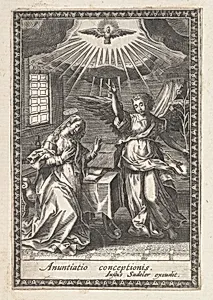
The Annunciation
1590–ca. 1620
Medium
Engraving
Dimensions
Sheet: 3 3/8 × 2 5/16 in. (8.6 × 5.8 cm)
Classification
Prints
Department
Drawings and Prints
Museum
Metropolitan Museum of Art, New York, NY
Credit
Harris Brisbane Dick Fund, 1953
Accession Number
53.601.12(51)
Rights
Public Domain
Tags
Art Historical Context
Behold *The Annunciation*, a engraving from the late 16th to early 17th century, attributed to Justus Sadeler or an anonymous artist of the Sadeler family, renowned Flemish printmakers. This intimate scene captures the biblical moment when the Archangel Gabriel announces the Virgin Mary that she conceive the Christ child—a cornerstone of Christian iconography. Produced around 1590–ca. 1620, it the Mannerist style prevalent in Northern Europe, with its elegant lines and spiritual intensity, during a time when engravings democratized religious art for personal devotion. Crafted on a tiny sheet measuring just 3 3/8 × 2 5/16 inches (8.6 × 5.8 cm), this print exemplifies the precision of engraving technique: a burin incises fine lines into a metal plate, capturing intricate details like flowing drapery and expressive gestures. Such small-scale works were affordable and portable, allowing pilgrims and the faithful to carry sacred imagery. Acquired through the Harris Brisbane Dick Fund in 1953, it resides in the Metropolitan Museum of Art's Drawings and Prints department. This artwork underscores engraving's role in the Counter-Reformation era, spreading Catholic devotion amid religious upheaval. Its modest size belies its cultural weight, inviting quiet contemplation of divine mystery.