
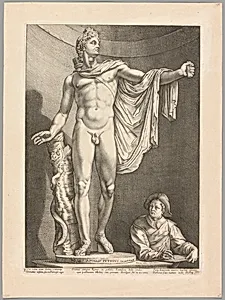
The Apollo Belvedere, plate 3 from Three Famous Antique Sculptures
c. 1592, printed c. 1617
Medium
Engraving in black on cream laid paper
Dimensions
Image: 40.5 × 29.1 cm (16 × 11 1/2 in.); Plate: 41.6 × 29.8 cm (16 7/16 × 11 3/4 in.); Sheet: 49.2 × 36.5 cm (19 3/8 × 14 3/8 in.)
Classification
engraving
Department
Prints and Drawings
Museum
Art Institute of Chicago
Accession Number
112043
Rights
Public Domain
About this artwork
Hendrick Goltzius was one of many Netherlandish artists who felt compelled to travel to Italy as part of his artistic training. Following a visit to Rome in 1591, Goltzius designed three ambitious prints that captured the experience of studying the monuments of Classical antiquity through the act of drawing. His prints present the awesome experience of encountering celebrated sculptures such as the Apollo Belvedere. The towering height of the sculpture emphasizes the feeling of humility provoked...
Art Historical Context
Hendrick Goltzius, a leading Dutch Mannerist engraver the late 16th century, createdThe Apollo Belvedere, 3 from Three Famous Sculptures* around 1592, with prints produced posthumously circa 1617. This engraving captures the iconic ancient Roman marble statue of Apollo, unearthed in the Renaissance and revered as the epitome of classical male beauty and contrapposto pose. Goltzius' reproductive print brought the Belvedere's graceful anatomy and dynamic tension to Northern European audiences, who rarely saw such antiquities firsthand. Masterfully executed in black ink on cream laid paper (image 40.5 × 29.1 cm), Goltzius employed his signature swelling line technique—known as the "Goltzius line"—to mimic the sculpture's three-dimensional volume and luminous marble surface. As a pioneer of printmaking, he transformed engraving, an intaglio process incising lines into copper plates, into a medium rivaling painting in expressiveness. This allowed collectors, artists, and scholars to study and own precise replicas, fueling the era's fascination with Greco-Roman ideals during the Dutch Golden Age. Housed in the Art Institute of Chicago's Prints and Drawings department, this work exemplifies how prints democratized art history, bridging antiquity with the Renaissance revival and influencing generations of artists from Rubens to neoclassicists. A testament to Goltzius' virtuosity, it invites viewers to marvel at the enduring allure of Apollo's poised perfection.
About the Artist
Hendrick Goltzius · 1558–1617
Hendrick Goltzius (1558–1617) was the most celebrated engraver of the Northern Renaissance and a pivotal figure in Dutch Mannerism. Born near the German-Dutch border, Goltzius transformed printmaking into a virtuoso art form through his revolutionary 'swelling line' technique, where the burin was manipulated to create lines of varying thickness that produced unprecedented tonal effects and three-d...