
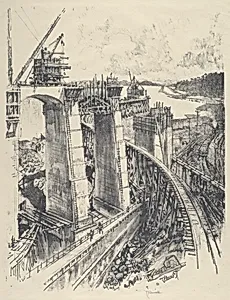
The Approach to Gatun Lock
1912
Medium
lithograph
Classification
Department
CG-W
Museum
National Gallery of Art, Washington, D.C.
Credit
Gift of Miss Elisabeth Achelis
Accession Number
1942.6.58
Rights
Public Domain
Art Historical Context
Joseph Pennell's *The Approach to Gatun* (1912) captures a pivotal moment in one of the 20th century's greatest engineering triumphs: the construction of the Panama Canal. ships neared the massive Gatun Locks—the world's largest then, designed to lift vessels 85 feet above sea level—this lithograph depicts the monumental scale of human ambition amid the tropical landscape. Pennell, a leading American printmaker and illustrator known for his dramatic renderings of industrial marvels, documented the canal's progress during its U.S.-led phase (1904–1914), highlighting America's emergence as a global superpower through feats of technology and labor. Rendered in lithography—a versatile medium Pennell mastered— the work employs bold, fluid lines and stark contrasts to convey motion and immensity. Lithography, invented in the late 18th century, allowed artists like Pennell to produce intricate, tonal images from a single stone plate, bridging fine art and mass reproduction. His realistic yet dynamic style, influenced by the era's fascination with modernity, evokes the awe of beholding these concrete behemoths rising from the jungle. Today, this print, a gift from Miss Elisabeth Achelis to the National Gallery of Art, reminds visitors of the Panama Canal's enduring legacy in facilitating world trade and symbolizing progress. Pennell's keen eye turns engineering into poetry, inviting us to marvel at humanity's bold horizons.
About the Artist
Joseph Pennell · 1857–1926
Joseph Pennell (1857–1926) was born in Philadelphia to Quaker parents and displayed an early aptitude for drawing, finding solace in sketching amid a challenging childhood. He received initial drawing instruction from James R. Lambdin and his first etching lessons from Stephen Ferris in 1879. Pennell attended night classes at the Pennsylvania Museum and School of Industrial Art before studying at ...