
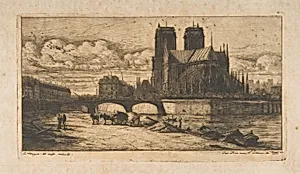
The Apse of Notre-Dame, Paris
1854
Medium
Etching with engraving and drypoint on laid paper; fourth state of nine
Dimensions
plate: 6 1/2 x 11 13/16 in. (16.5 x 30 cm)
Classification
Prints
Department
Drawings and Prints
Museum
Metropolitan Museum of Art, New York, NY
Credit
Bequest of Susan Dwight Bliss, 1966
Accession Number
67.630.26
Rights
Public Domain
Tags
Art Historical Context
Step into the intricate world of 19th-century Paris with Charles Meryon's *The Apse of Notre-Dame, Paris* (1854), a masterful etching with engraving and drypoint on laid paper. This fourth state of nine captures the majestic apse of Notre-Dame Cathedral from across the Seine, framed by bridges and boats dotting the river. At 6 1/2 x 11 13/16 inches, the plate's fine details evoke the bustling yet timeless riverside scene, now housed in the Metropolitan Museum of Art's Drawings and Prints department, thanks to the bequest of Susan Dwight Bliss in 1966. Meryon, a pioneering French etcher often called the "Rembrandt of Paris," documented the city's Gothic architecture just before Baron Haussmann's transformative renovations modernized its medieval fabric. His work bridges Romanticism and Realism, celebrating vanishing urban landmarks with haunting precision. This print highlights Notre-Dame's soaring apse—a symbol of medieval faith and engineering—amid everyday life, blending the sacred with the profane. The layered techniques shine here: etching for bold lines, engraving for depth, and drypoint for velvety burrs that add atmospheric richness. As one of multiple states, it reveals Meryon's meticulous refinement process, inviting viewers to ponder Paris's enduring allure and the artistry of preservation.
About the Artist
Charles Meryon · 1821–1868
Charles Meryon, born on November 23, 1821, in Paris, was the illegitimate son of English physician Dr. Charles Lewis Meryon and dancer Pierre-Narcisse Chaspoux (stage name Narcisse Gentil) at the Paris Opéra. His half-sister Fanny, from his mother's prior relationship with Viscount Lowther, remained in contact after their mother's death in 1838. Raised partly outside Paris before attending Pension...