
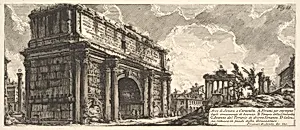
The Arch of Septimius Severus (Arco di Severo, e Caracalla)
ca. 1756
Medium
Etching
Dimensions
Plate: 4 1/2 × 10 11/16 in. (11.5 × 27.2 cm) Sheet: 7 3/8 × 12 15/16 in. (18.8 × 32.9 cm)
Classification
Prints
Department
Drawings and Prints
Museum
Metropolitan Museum of Art, New York, NY
Credit
Gift of Louise Bechtel, 1958
Accession Number
58.580.13
Rights
Public Domain
Tags
Art Historical Context
Giovanni Battista Piranesi’s captures the enduring grandeur of’s ancient monuments through Arch of Septimius Severus, a triumphal structure erected in 203 CE to commemorate the emperor’s military victories. Created around 1756 as part of Piranesi’s celebrated views of the city, the print highlights the arch’s weathered stone and intricate carvings, drawing attention to the passage of on classical architecture. Piranesi, a leading figure in 18th-century printmaking, specialized in detailed etchings that blended archaeological precision with dramatic perspective. His works helped fuel the era’s fascination with antiquity, inspiring travelers and artists across Europe to appreciate Rome’s ruins not merely as relics but as symbols of cultural achievement. The medium of etching allowed Piranesi to render fine textures and deep shadows, giving the scene a sense of monumentality despite the print’s modest size. Today, this piece in the Metropolitan Museum of Art’s collection invites viewers to reflect on how such images preserved and romanticized the legacy of imperial Rome for modern audiences.
About the Artist
Giovanni Battista Piranesi · 1720–1778
Giovanni Battista Piranesi (1720–1778) was an Italian printmaker, architect, and antiquarian whose visionary etchings of Rome and imaginary prisons revolutionized architectural representation and profoundly influenced both Neoclassicism and Romanticism. Piranesi stands as one of the most important printmakers of the eighteenth century, fundamentally shaping European perceptions of ancient Rome an...