
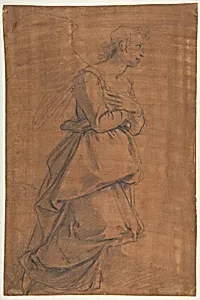
The Archangel Gabriel Kneeling to the Right; Small Study of Head at Lower Left.
late 16th century
Medium
Black chalk, small traces of white chalk highlights, on ochre brown prepared paper; some unrelated scribbles and sketches in red chalk
Dimensions
sheet: 16 1/2 x 11 in. (41.9 x 27.9 cm)
Classification
Drawings
Department
Drawings and Prints
Museum
Metropolitan Museum of Art, New York, NY
Credit
Harry G. Sperling Fund, 2001
Accession Number
2001.503
Rights
Public Domain
Tags
Art Historical Context
This striking chalk drawing by Jacopo da Empoli captures the Archangel Gabriel in a moment of graceful reverence, kneeling with wings folded and head bowed. Created in late 16th-century Florence, the sheet reflects the artist’s training in the Mannerist tradition while hinting at the emerging naturalism of the early Baroque. As a preparatory study, it likely served as a working model for a larger altarpiece or fresco depicting the Annunciation, a subject that remained central to Florentine religious art. Empoli’s technique reveals both economy and sensitivity. Working on warm ochre prepared paper, he used black chalk to define the figure’s drapery and anatomy with fluid, confident strokes, adding delicate white highlights to suggest the play of light across Gabriel’s robes. The small head study at lower left demonstrates the artist’s habit of refining expressions and features separately before integrating them into the final composition. Such drawings were prized in Renaissance workshops for their immediacy and insight into the creative process. Acquired by the Metropolitan Museum through the Harry G. Sperling Fund, this sheet offers visitors a rare glimpse into how a skilled Florentine draftsman prepared monumental religious imagery for church settings.
About the Artist
Jacopo da Empoli (Jacopo Chimenti) · 1551–1640
**Jacopo da Empoli (Jacopo Chimenti)** was an Italian painter born on 30 April 1551 in Florence and who died there on 30 September 1640. He became known by the name of his father’s birthplace, Empoli, and worked primarily in his native city as a leading figure in the Florentine Reformist or Counter-Mannerist movement. He apprenticed under Maso da San Friano and drew inspiration from earlier Manne...