
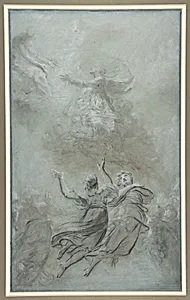
The Assumption of the Virgin
ca. 1816–19
Medium
Black and white chalk on blue paper
Dimensions
18 3/8 x 11 7/8 in. (46.7 x 30.2 cm)
Classification
Drawings
Department
Drawings and Prints
Museum
Metropolitan Museum of Art, New York, NY
Credit
Rogers Fund, 1937
Accession Number
37.165.105
Rights
Public Domain
Tags
Art Historical Context
Pierre Paul Prud'hon’s *The Assumption of the Virgin (ca. 1816–19) captures the moment of Mary’s ascent into heaven, a beloved theme in Christian art. Created as a drawing rather than a finished painting, the work reveals the French artist’s sensitive approach during the transition from Neoclassicism to Romanticism. Prud’hon, admired for his poetic handling of light and form, often used such studies to explore dramatic compositions destined for larger projects. The choice of black and white chalk on blue paper is especially effective here. The cool-toned sheet acts as a mid-ground, allowing the artist to build luminous highlights and velvety shadows that give the figures a soft, ethereal glow. This technique, reminiscent of Renaissance masters, lets viewers feel both the weightlessness of the ascending Virgin and the awe of the surrounding figures. Acquired by the Metropolitan Museum of Art in 1937 through the Rogers Fund, the drawing offers an intimate glimpse into Prud’hon’s creative process. Its modest size—roughly 18 by 12 inches—invites close looking, rewarding visitors with the quiet drama of chalk strokes that seem to dissolve into heavenly light.
About the Artist
Pierre Paul Prud'hon · 1758–1823
Pierre Paul Prud'hon (1758–1823) was a French painter and draughtsman whose dreamy, sensuous art occupied a singular position between the Neoclassicism and Romanticism that competed for dominance in French painting around 1800. Born in Cluny in Burgundy, he received his early artistic training at the Dijon Academy before winning the Prix de Rome of the Estates of Burgundy, which allowed him to spe...