
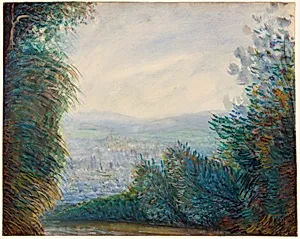
The Auvers Valley on the Oise River
after 1884
Medium
Gouache and watercolor, with touches of scraping, on ivory wove paper
Dimensions
24 × 30.3 cm (9 1/2 × 11 15/16 in.)
Classification
prints and drawing
Department
Prints and Drawings
Museum
Art Institute of Chicago
Accession Number
186430
Rights
Public Domain
Art Historical Context
Pierre-Auguste Renoir'sThe Auvers Valley on Oise River*, created after 1884, captures the lush, sun-dappled landscapes of northern France in a delicate gouache and watercolor on ivory wove paper. just 24 × 30.3 cm, this intimate drawing showcases Renoir's Impressionist mastery of light and color, even in works on paper. The Auvers Valley along the Oise River, near Paris, was a favored motif for plein-air artists, evoking the serene beauty that inspired Renoir during his evolving career. Renoir's technique here blends the transparency of watercolor with gouache's opacity, enhanced by subtle scraping for textured effects—revealing his innovative approach to mixed media. As a leading Impressionist, he prioritized fleeting atmospheric effects over precise lines, rendering the valley's rolling hills, river reflections, and vibrant foliage with loose, luminous strokes. This piece reflects his post-1880s experimentation, bridging oil paintings and drawings. Housed in the Art Institute of Chicago's Prints and Drawings department, *The Auvers Valley* offers visitors a window into Renoir's portable sketchbook world, highlighting how such small-scale works fueled his grand canvases. A gem for admirers of Impressionism's joyful embrace of nature.
About the Artist
Pierre-Auguste Renoir · 1841–1919
Pierre-Auguste Renoir (1841-1919) was a founding figure of Impressionism whose luminous depictions of Parisian leisure, sensuous female forms, and sun-dappled landscapes made him one of the most beloved painters in Western art history. Born in Limoges to a working-class family, Renoir began as a porcelain painter before pursuing fine arts, and this early craft experience gave him facility with the...