
The Ball
ca. 1634
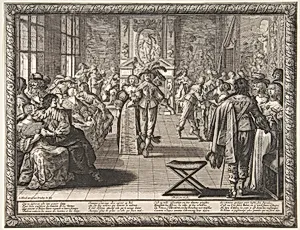
Medium
Etching and engraving; second state of two
Dimensions
Sheet (trimmed): 10 7/16 × 13 1/2 in. (26.5 × 34.3 cm)
Classification
Prints
Department
Drawings and Prints
Museum
Metropolitan Museum of Art, New York, NY
Credit
The Elisha Whittelsey Collection, The Elisha Whittelsey Fund, 1951
Accession Number
51.501.2268
Rights
Public Domain
Tags
Art Historical Context
Step into the lively whirl of 17th-century French society with *The Ball*, a captivating etching and engraving created around 1634 by Abraham Bosse, with engraving assistance from Jean I Leblond. This second-state impression captures an elegant interior scene alive with men and women dancing, their figures swirling in a grand ballroom. Trimmed to 10 7/16 × 13 1/2 inches, the print showcases the meticulous detail possible through combined etching—for fluid lines and textures—and engraving—for precise, durable marks—techniques that allowed Bosse's intricate compositions to be widely reproduced. Bosse, a master of French Baroque printmaking, excelled at documenting everyday social rituals, from markets to galas, offering a vivid window into the reign of Louis XIII. Balls like this one were central to courtly and bourgeois life, blending courtship, music, and display in opulent interiors. This work reflects the era's growing interest in genre scenes, bridging art and social commentary, and influenced later realist movements. Housed in the Metropolitan Museum of Art's Drawings and Prints department (The Elisha Whittelsey Collection, 1951), *The Ball* invites us to imagine the rustle of silks and strains of violins, preserving a fleeting moment of joy for modern eyes.
About the Artist
Abraham Bosse|Jean I Leblond · 1602–1676
Abraham Bosse (1604–1676) was a French printmaker and theorist whose approximately 1,600 etchings provide an unparalleled visual record of 17th-century French life. Born to Huguenot parents in Tours, he trained in Paris under Melchior Tavernier and became a devoted follower of Jacques Callot's technical innovations. Bosse's meticulous etchings depicted subjects ranging from daily life and fashion ...