
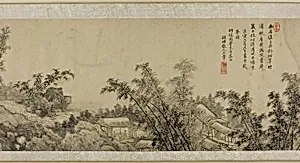
The Bamboo Slope 竹坡圖
Qing dynasty (1644–1912), 1710
Medium
Handscroll; ink on paper
Dimensions
25.8 × 459.8 cm (10 1/8 × 181 in.)
Classification
handscroll
Department
Arts of Asia
Museum
Art Institute of Chicago
Accession Number
84767
Rights
Public Domain
Art Historical Context
Step into the serene world of Qing dynasty landscape painting with *The Bamboo Slope* (竹坡圖), a handscroll created by Wang Hui in 1710. Wang Hui (1632–1717), one of the revered "Four Wangs," a leading figure in the Orthodox School, which sought to revive the grand traditions of earlier masters like Dong Qich and the Yuan literati painters. This work, housed in the Art Institute of's Arts of Asia department exemplifies his ability to capture nature's poetic harmony through ink on paper, measuring an expansive 25.8 × 459.8 cm when fully unrolled. As a handscroll, *The Bamboo Slope* invites viewers to experience it sequentially, unrolling like a narrative journey through mist-shrouded bamboo groves and rugged slopes. Wang Hui's virtuoso brushwork employs layered ink washes and precise "cun" (textural strokes) to evoke depth, texture, and atmospheric perspective—techniques rooted in Song and Yuan innovations. Bamboo, a symbol of resilience and integrity in Chinese culture, dominates the composition, reflecting Confucian ideals cherished by Qing scholar-artists. This artwork's cultural significance lies in its role as a bridge between imperial patronage and personal expression, showcasing the Qing era's reverence for antiquity amid political transition. A true gem for contemplation, it transports visitors to an timeless realm of quiet majesty.
About the Artist
Wang Hui · 1632–1717
Chinese, 1632–1717