
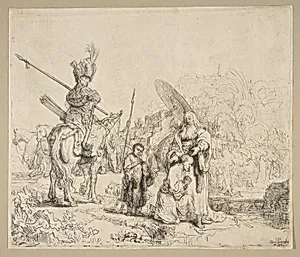
The Baptism of The Eunuch
Medium
Etching, touches of gray wash; second of four states
Dimensions
Sheet (Trimmed): 7 1/4 × 8 9/16 in. (18.4 × 21.7 cm)
Classification
Prints
Department
Drawings and Prints
Museum
Metropolitan Museum of Art, New York, NY
Credit
Gift of Jesse Howard Jr., 1922
Accession Number
22.52.3
Rights
Public Domain
Tags
Art Historical Context
In the heart of Rembrandt van Rijn's masterful printmaking career during the Dutch Golden Age, *The Baptism of The Eun* (1641) a pivotal biblical moment from the Book of Acts (8:26-40). Here, the apostle Philip baptizes the Ethiopian official in a roadside stream, symbolizing early Christian conversion. Rembrandt populates the scene with vivid figures—men, boys, soldiers, and horses—oking the eunuch's royal entourage and the drama of divine encounter. This etching reflects the artist's deep engagement with religious narratives, blending spiritual intimacy with everyday humanity. Printed as the second of four states, this work showcases Rembrandt's innovative etching technique, where he refined plates through multiple impressions, adding intricate lines for texture and depth. Subtle touches of gray wash enhance shadows and volume, transforming the modest 7 1/4 × 8 9/16 in. sheet into a luminous tableau. As a Baroque master, Rembrandt's command of light and emotion in prints like this rivaled his paintings, making fine art accessible beyond oil canvases. Housed in the Metropolitan Museum of Art's Drawings and Prints department (gift of Jesse Howard Jr., 1922), this piece highlights Rembrandt's experimental genius, inviting visitors to ponder faith's quiet triumphs amid life's bustle.
About the Artist
Rembrandt (Rembrandt van Rijn) · 1606–1669
Rembrandt Harmenszoon van Rijn (1606–1669) stands as one of the greatest visual artists in the history of Western art and the most important Dutch painter of the 17th century. Born in Leiden to a prosperous miller's family, Rembrandt transformed painting through his revolutionary use of light and shadow, his psychological depth in portraiture, and his elevation of etching to a fine art. His approx...