
The Barber
1632–33
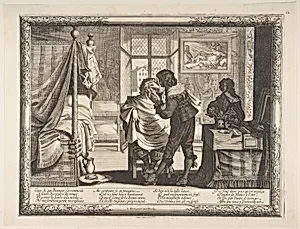
Medium
Etching; first state of two (Duplessis)
Dimensions
Sheet: 11 x 14 1/2 in. (28 x 36.8 cm) Plate: 10 1/16 x 13 3/16 in. (25.5 x 33.5 cm)
Classification
Prints
Department
Drawings and Prints
Museum
Metropolitan Museum of Art, New York, NY
Credit
Harris Brisbane Dick Fund, 1926
Accession Number
26.49.60
Rights
Public Domain
Tags
Art Historical Context
Step into the bustling world of 17th France with *The Barber* (1632–33), a captivating etching by master printmaker Abraham Bosse in collaboration with Jean I Leond. This first-state impression—before any alterations were made to the plate—offers a pristine glimpse into Bosse's meticulous technique. Measuring about 11 x 14½ inches, it hails from the Metropolitan Museum of Art's Drawings and Prints collection, through the Harris Brisbane Dick Fund 1926. Bosse, a leading figure in French Baroque printmaking, excelled at etching genre scenes that captured everyday life with remarkable detail and realism. Here, the composition centers on men at work in a barber's shop, complete with chairs and tools, evoking the lively street trades of Paris during Louis XIII's reign. Etching allowed Bosse to achieve fine lines and textures, rendering fabrics, faces, and furniture with lifelike precision—a technique that democratized art by making affordable prints widely accessible. This work's historical charm lies its snapshot of ordinary labor, highlighting the social fabric of early modern Europe. As a rare first state (noted by scholar Duplessis), it holds special appeal for collectors, preserving the artist's original vision before revisions. A delightful window into the past!
About the Artist
Abraham Bosse|Jean I Leblond · 1602–1676
Abraham Bosse (1604–1676) was a French printmaker and theorist whose approximately 1,600 etchings provide an unparalleled visual record of 17th-century French life. Born to Huguenot parents in Tours, he trained in Paris under Melchior Tavernier and became a devoted follower of Jacques Callot's technical innovations. Bosse's meticulous etchings depicted subjects ranging from daily life and fashion ...