
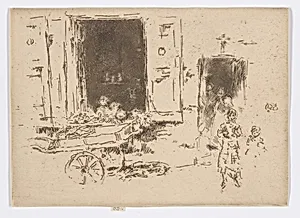
The Barrow- Quartier des Marolles, Brussels
Classification
Department
Smithsonian Collection
Museum
Smithsonian American Art Museum
Credit
Gift of Charles Lang Freer
Accession Number
F1888.9
Rights
Public Domain
Tags
About this artwork
Whether by design or by accident, Whistler’s small, stage-like, close-cropped images echo urban photographs by John Thomson, a documentarian of lower- and working-class London neighborhoods. The Barrow recalls Thomson’s Cheap Fish of St. Giles from the book Street Life in London. The book included articles juxtaposed with photographs “taken from life,” meant to provide “unquestionable accuracy” of the urban poor’s marginal existence. Yet, like Whistler’s images, these photographs were carefully ...
Art Historical Context
James McNeill Whistler’s 1887 print *The Barrow—Quartier des Marolles, Brussels* captures a modest street scene in one of the Belgian capital’s working-class neighborhoods. The small, tightly framed composition focuses on a simple market barrow and storefront, inviting viewers to linger over everyday details rather than grand architecture. Created during Whistler’s extensive European travels, the image reflects his lifelong interest in urban vignettes that blend observation with careful arrangement. The work echoes the documentary photographs of John Thomson, whose 1877 book *Street Life in London* paired images of the urban poor with written accounts. Like Thomson’s carefully posed scenes, Whistler’s etching presents a seemingly spontaneous moment that was in fact thoughtfully composed. As a print gifted by Charles Lang Freer to the Smithsonian American Art Museum, it highlights Whistler’s mastery of the etching medium and his contribution to the late-nineteenth-century revival of printmaking as a serious art form. Whistler’s close cropping and subtle tonal range transform an ordinary Brussels street into a quiet study of light, texture, and modern city life, encouraging today’s visitors to consider how artists and photographers alike shaped public perceptions of the urban poor.