
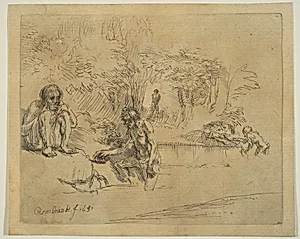
The Bathers
Medium
Etching; third of three states
Dimensions
Sheet: 4 3/4 × 5 13/16 in. (12 × 14.7 cm)
Classification
Prints
Department
Drawings and Prints
Museum
Metropolitan Museum of Art, New York, NY
Credit
Bequest of Harry G. Friedman, 1965
Accession Number
66.521.37
Rights
Public Domain
Tags
Art Historical Context
Step into the intimate world of Rembrandt van R's *The Bathers* (1651), a masterful etching now housed in the Metropolitan Museum Art's Drawings and Prints. This small-scale print, measuring just 4 3/4 × 5 13/16 inches (12 × 14.7 cm), depicts a group of men engaged in bathing—a theme drawn from everyday life yet infused with classical echoes. Acquired through the bequest of Harry G. Friedman 1965, it the third and final state of three, showcasing Rembrandt's iterative refinement process. As a cornerstone of the Dutch Golden Age and Baroque art, Rembrandt revolutionized etching, a technique where acid bites into a metal plate along incised lines to hold ink, allowing for intricate textures and tonal depth. In this state, the composition achieves remarkable richness: soft shadows envelop the figures, highlighting muscular forms and rippling water with painterly subtlety. Rembrandt's genius lies in mimicking oil painting's luminosity using only black ink on white paper, creating a sense of immediacy and humanity. *The Bathers* exemplifies Rembrandt's printmaking prowess—he produced around 300 etchings, blending naturalism with emotional depth. For visitors, it offers a window into 17th-century life, where male nudes celebrated the body's vitality, bridging Renaissance ideals and emerging realism in Northern European art. A gem for print enthusiasts!
About the Artist
Rembrandt (Rembrandt van Rijn) · 1606–1669
Rembrandt Harmenszoon van Rijn (1606–1669) stands as one of the greatest visual artists in the history of Western art and the most important Dutch painter of the 17th century. Born in Leiden to a prosperous miller's family, Rembrandt transformed painting through his revolutionary use of light and shadow, his psychological depth in portraiture, and his elevation of etching to a fine art. His approx...