
The Beggars
ca. 1509
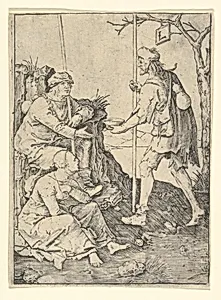
Medium
Engraving
Classification
Prints
Department
Drawings and Prints
Museum
Metropolitan Museum of Art, New York, NY
Credit
Bequest of Grace M. Pugh, 1985
Accession Number
1986.1180.202
Rights
Public Domain
Tags
Art Historical Context
**The Beggars**, an engraving created around 1509 by the Dutch artist Lucas van Leyden, captures a poignant moment of everyday hardship. Van Leyden, a prodigious talent from Leiden who lived from 1494 to 1533, was a master of the Northern Renaissance, renowned for his intricate prints that brought genre scenes to life with remarkable detail. This early work, housed in the Metropolitan Museum of Art's Drawings and Prints department (bequest of Grace M. Pugh, 1985), exemplifies his skill in depicting ordinary men—likely beggars—in a way that humanizes their plight. Engravings like this one were revolutionary in the early 16th century, allowing artists to produce multiple impressions from a single copper plate, democratizing art beyond elite patrons. Van Leyden's technique shines through fine lines that convey texture in ragged clothing and expressive faces, blending realism with subtle narrative depth. Produced during the Renaissance's shift toward secular subjects, it reflects growing interest in social realities amid economic changes in the Netherlands. Today, *The Beggars* invites visitors to ponder themes of poverty and resilience, a timeless reminder of art's power to illuminate human experience. As one of van Leyden's foundational prints, it showcases his influence on later Dutch masters like Rembrandt.
About the Artist
Lucas van Leyden · 1484–1533
Lucas van Leyden (1494–1533) was a Dutch painter and printmaker who stands among the greatest engravers of the Northern Renaissance. Born in Leiden as either Lucas Hugensz or Lucas Jacobsz, he lived and worked primarily in his native city, achieving international renown that rivaled the German master Albrecht Dürer. Lucas van Leyden revolutionized Netherlandish printmaking and was among the first...