
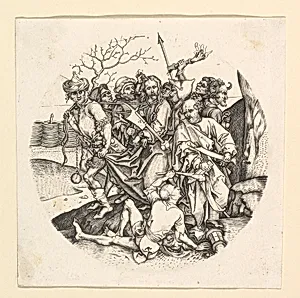
The Betrayal of Christ (reverse copy in roundel)
late 15th–16th century
Medium
Engraving
Dimensions
Plate: 4 1/4 in. (10.8 cm) Sheet: 4 3/4 × 4 5/8 in. (12.1 × 11.7 cm)
Classification
Prints
Department
Drawings and Prints
Museum
Metropolitan Museum of Art, New York, NY
Credit
Gift of Felix M. Warburg and his family, 1941
Accession Number
41.1.211
Rights
Public Domain
Tags
Art Historical Context
In the dimly lit glow of a Renaissance workshop, Martin Schongauer's *The Betrayal of Christ (reverse copy in roundel)* captures the tense drama of Judas's infamous kiss, as soldiers with swords and clubs seize Jesus in the Garden of Gethsem. This late 15th- to early 16th-century engraving presented in a distinctive circular "roundel" format, the composition of Schongauer's original, creating a mirrored intimacy that draws viewers into the biblical betrayal. Tags highlighting Christ, weapons, and men evoke the raw emotion and violence of the moment, a staple of Christian iconography. Schongauer, a pioneering German engraver bridging Late Gothic and Northern Renaissance styles, was renowned for his intricate line work and expressive figures—qualities that made his prints highly sought after and frequently copied across Europe. Engraving, as a medium, revolutionized art by allowing affordable reproduction and dissemination of sacred images, influencing masters like Albrecht Dürer. This small-scale work (plate just 4¼ inches across) exemplifies the technical precision of copperplate engraving, where fine burin lines build depth, texture, and shadow. Housed in the Metropolitan Museum of Art's Drawings and Prints department—a gift from Felix M. Warburg and family in 1941—this piece underscores the era's devotion to religious narrative art. It invites modern visitors to ponder how such portable prints brought profound spiritual stories into everyday life, blending artistry with faith.
About the Artist
Martin Schongauer · 1435–1491
Martin Schongauer, born around 1450–1453 in Colmar, Alsace, emerged from a family of skilled artisans. The third of four or five sons of goldsmith Caspar Schongauer, who had relocated from Augsburg to Colmar around 1440, Martin was immersed in the goldsmith's trade from youth, likely receiving his initial training in his father's workshop—a common path for early engravers. He further honed his ski...