
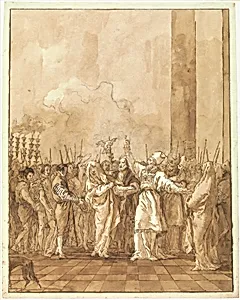
The Betrothal of the Virgin
ca. 1770
Medium
Pen and brown ink, brown wash, over black chalk.
Dimensions
19 x 15 3/16 in. (48.3 x 38.6 cm)
Classification
Drawings
Department
Robert Lehman Collection
Museum
Metropolitan Museum of Art, New York, NY
Credit
Robert Lehman Collection, 1975
Accession Number
1975.1.514
Rights
Public Domain
Tags
Art Historical Context
Giovanni Domenico Tiepolo's *The Betrothal of the* (ca. 1770) captures a pivotal biblical moment from the apocryphal Gospel of James, where the Virgin Mary is formally betrothed to Joseph a gathered crowd. As the son of the illustrious Venetian Rococo master Giovanni Battista Tiepolo, inherited and refined his father's exuberant style, infusing this scene with lively figures, dramatic gestures, and a sense of communal festivity. The drawing reflects the Tiepolo family's enduring popularity in 18th-century Venice, where such religious narratives blended spiritual devotion with theatrical flair. Executed in pen and brown ink with brown wash over black chalk—a hallmark of Venetian draftsmanship—this preparatory work demonstrates Domenico's virtuoso technique. The fluid lines and subtle tonal modeling create depth and movement, evoking the Rococo emphasis on elegance and light. At 19 x 15 3/16 inches, its intimate scale invites close contemplation, highlighting the artist's skill in rendering crowded compositions with individual character. Housed in the Robert Lehman Collection at The Metropolitan Museum of Art since 1975, this drawing exemplifies the Tiepolos' legacy in graphic arts, bridging painting and fresco traditions. It offers visitors a glimpse into the creative process of one of Europe's great artistic dynasties, where faith and fantasy intertwined.
About the Artist
Giovanni Domenico Tiepolo · 1727–1804
Giovanni Domenico Tiepolo (1727-1804) was a Venetian painter, printmaker, and draftsman whose career spanned the twilight of the Rococo era. Born on August 30, 1727, in Venice as the eldest son of the celebrated Giovanni Battista Tiepolo, he worked both in his father's shadow and as a significant independent artist who developed a distinctly earthbound and humanistic vision. Domenico's importance...